



Oleh Romaniuk
February 11, 2026
Top 7 Contact Center Metrics to Monitor Daily | Teliqon Insights
Ever felt a quiet sense of dread after checking the dashboard?… You’re not alone.
Daily metrics are supposed to help you stay in control. In practice, many teams end up tracking too much and understanding too little. You check yesterday’s reports, jump into meetings, but only later realize the warning signs were there early on, hiding in plain sight.
This article is about contact center productivity metrics that actually earn a spot on your daily checklist. Think of it as a short list you’d trust enough to glance at between calls and still feel grounded about how the day is really unfolding.
Customer satisfaction
When you’re running a contact center, clarity is usually what you’re missing most on the days that feel hardest. Customer satisfaction sounds obvious until you’re the one trying to keep an eye on call center daily reports. This is where the right tools help turn instinct into something clearer. Call recordings let you hear the story behind the numbers. Not to judge agents, but to understand where friction keeps repeating.
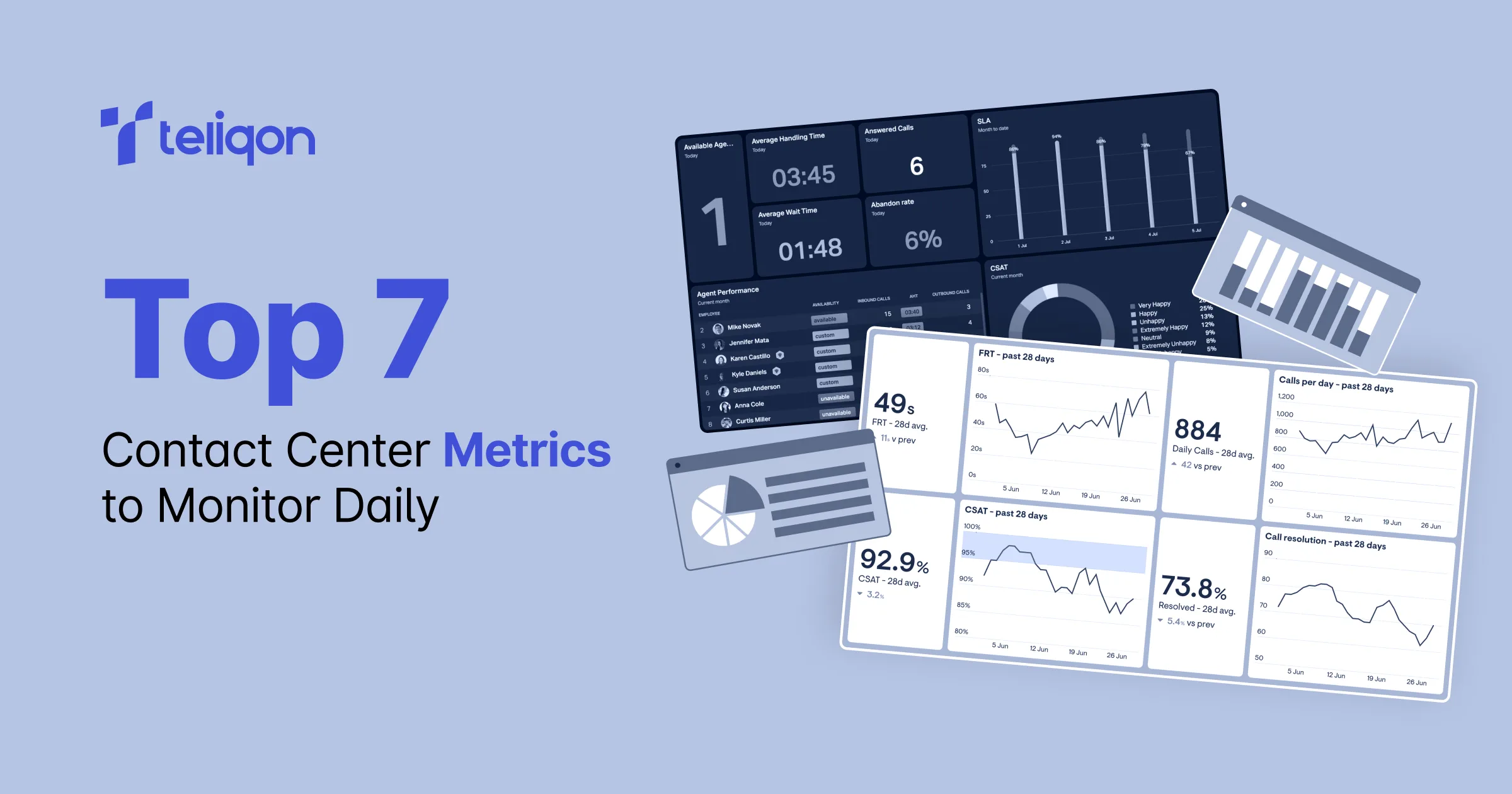
Real-time dashboards help you catch patterns during the day. Longer queues, more transfers, unusual spikes – while there’s still time to react. CRM integration adds the missing context, so agents don’t walk into conversations blind or force customers to explain everything again.
Put together, these tools don’t give you a perfect satisfaction score. What they give you is awareness.
You start seeing which parts of the experience wear customers down and which ones smooth things out. And once you can see that, improving satisfaction stops being a guessing game and starts feeling a lot more manageable — even on busy days.
Average response time
Average response time is one of those metrics that customers feel before they ever name it. They don’t think, “This took 42 seconds.” They think, “Am I being ignored?”
What makes this tricky is that response time isn’t just about speed. It’s about flow.
Teliqon helps keep that stretch visible. Real-time dashboards show how long customers are waiting right now, not later in a report when it’s too late to adjust.
One small but important detail: don’t mix channels together. A call, a chat, and a message don’t live by the same rules, and customers don’t expect them to. Track response time per channel so you can see where things are genuinely slow versus where expectations are simply different.
That separation is often where the real insight shows up.
Number of interactions
This metric is basically your contact center’s pulse. It tells you how much demand is actually coming in, not how busy things feel. And those two don’t always line up.
With Teliqon, interactions don’t disappear into separate buckets. Call Detail Records give you a clear count of every conversation, while omnichannel tracking keeps calls and messages visible in one place. Using custom filters, you can break volume down by channel, time window, or team and see what’s actually driving the load.
Looking at a call center daily analysis report helps you react in the moment. Looking at it over time helps you plan without panic. Real-time dashboards show when today is heavier than usual. Reporting tools let you step back and compare a normal week to a campaign launch or seasonal rush.
Post-interaction work time
The call ends. The chat closes. Then comes the follow-up work — notes, updates, and details that still need to be captured before the next interaction begins. When this part is clunky or fragmented, agents lose time simply moving between tools.
Teliqon reduces that friction by keeping call data and customer context in one place through CRM integration, so agents aren’t copying information from screen to screen. And if the process still feels heavy, the fix usually isn’t asking agents to move faster – it’s simplifying what they’re asked to complete, or removing tools that get in the way instead of helping.
Common queries
After a while, you start hearing the same questions again and again. Early on, these repeat conversations help shape what your help content should look like. Over time, they give you a practical contact center metrics benchmark — a way to see which issues are normal for your operation and which ones are creating unnecessary load.
By the way ith Teliqon, interactions can be tagged by reason during or after the conversation, without slowing agents down. Once those tags are in place, analytics do the everything. You can see which topics keep coming back, how often they appear, and whether they spike after changes on your site or in your product.
Conversion rate
Conversion rate connects contact center activity to actual business results. In that sense, it reflects more than sales performance — it shows how effective your interactions are overall.
There are a couple of ways to approach this. One option is a simple calculation: divide the number of interactions that resulted in a conversion by the total number of interactions. This gives a quick snapshot, but it assumes the decision happens during the conversation itself.
In reality, that’s rarely the case. Many customers convert after the interaction, sometimes days later. To capture this, interactions can be marked as warm leads and tracked over a defined period, such as a week. At the end of that window, you divide the number of customers who converted by the number of warm leads recorded during that time. This approach gives a clearer picture of how conversations influence outcomes beyond the immediate moment.
Oleh Romaniuk

Follow Us in social networks


The latest from Teliqon
Stay ahead with insights from the leader in trusted communications. Subscribe for the latest blogs, updates, and exclusive content.