




Arthur Kyselevskyi
October 6, 2026
What Is VoIP? | Teliqon Glossary
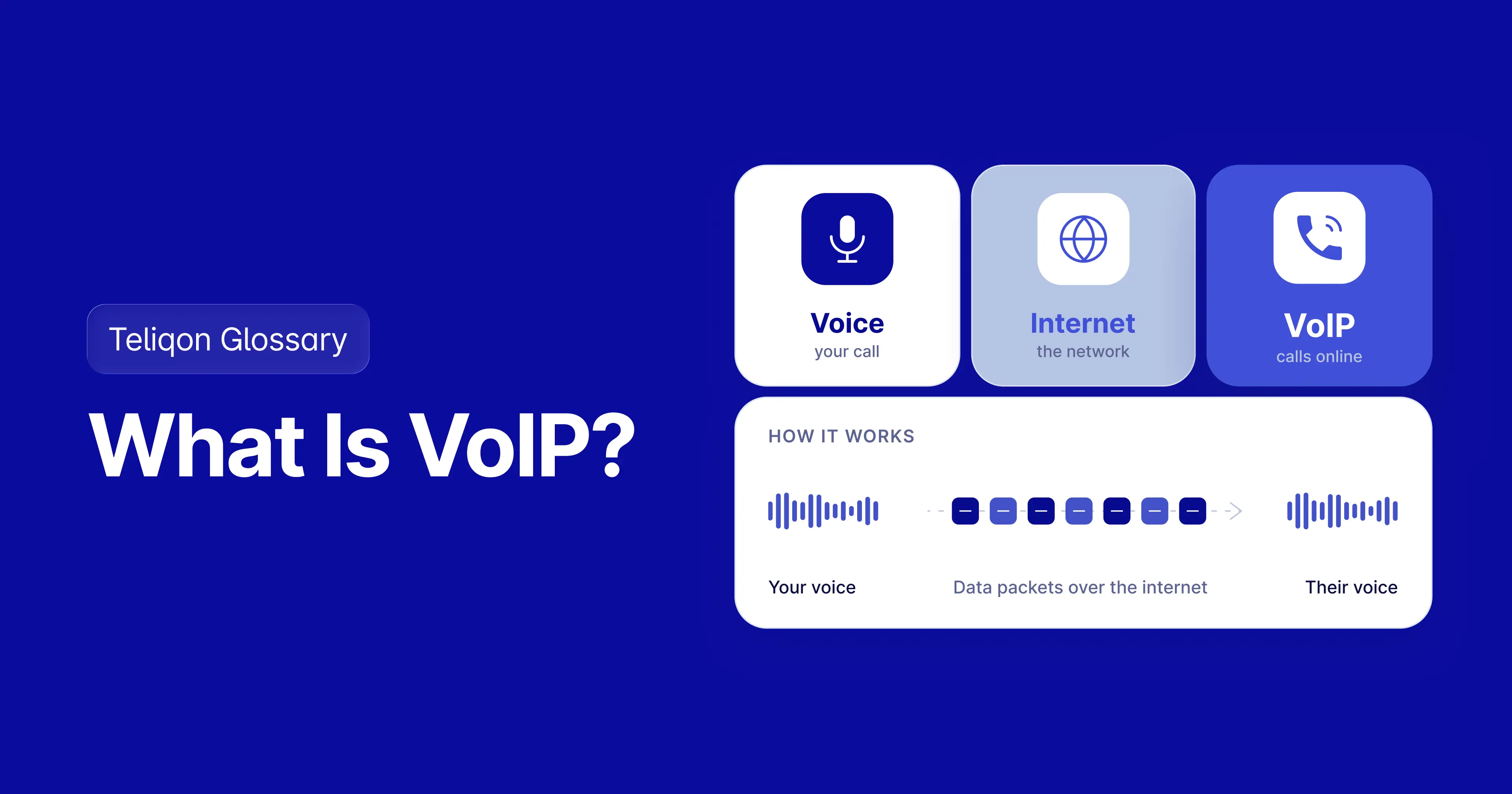
VoIP (Voice over Internet Protocol) is a technology that allows voice calls to be transmitted over IP networks instead of traditional telephone lines. It is widely used in modern business phone systems because calls can be made and received through IP phones, computers, mobile devices, and softphones.
Read on to learn how VoIP works, its key benefits, and how businesses use it.
What Is VoIP?
VoIP, or Voice over Internet Protocol, enables voice calls over IP networks rather than traditional telephone lines. It converts voice into digital audio data, divides it into packets, and transmits those packets over an IP network. VoIP can operate over the public internet or private IP networks, depending on the business communication setup.
Businesses use VoIP to make communication more flexible and easier to manage across teams and locations. Unlike traditional landlines, VoIP supports calls from desk phones, computers, smartphones, and other compatible devices.
How Does VoIP Work?
VoIP converts your voice into digital data packets, which travel through an IP network to their destination and are then converted back into audio for the recipient.
When a VoIP call is placed, the system establishes the connection over an IP network. The call may stay entirely within an IP environment, such as between SIP endpoints or within a private PBX. If the destination is a traditional mobile or landline number, the call can be routed through a VoIP provider or SIP trunk to the PSTN.
The process typically happens in a few steps:
1. Voice capture: A phone, headset, or other device captures your voice.
2. Digital conversion: VoIP technology converts the audio into digital data.
3. Data transmission: The data is divided into packets and sent across the IP network.
4. Call routing: The VoIP system routes the call to the correct destination.
5. Audio conversion: The packets are reassembled and converted back into audio for the recipient.
This process happens almost instantly, allowing a VoIP conversation to feel much like a regular phone call when the network connection is stable.
VoIP and SIP
VoIP describes the technology used to transmit voice over IP networks. SIP (Session Initiation Protocol) is one of the most commonly used protocols for establishing, managing, and ending VoIP calls.
What Is a VoIP Number?
A VoIP number is a telephone number used to make and receive calls through a VoIP system. To callers, it works like a regular phone number, but calls are handled over IP networks rather than being tied to a traditional telephone line.
Unlike a traditional landline, a VoIP number does not have to be tied to one physical phone or location.
Businesses can use it with compatible desk phones, computers, smartphones, and softphones, which makes it useful for remote teams and companies with multiple locations.
Businesses can also often keep their existing phone numbers when moving to VoIP through number porting.
The number is transferred from the current provider to the new VoIP provider, allowing customers to continue calling the same business number.
What Are the Advantages of VoIP for Businesses?
As businesses grow, add locations, or adopt remote work, traditional phone systems can become difficult to manage. VoIP addresses these challenges by providing an IP-based environment that is easier to scale, access, and integrate with other tools.
Easier scaling as your business grows
Traditional systems may require new phone lines and hardware when adding employees or locations. VoIP allows businesses to add users, extensions, and numbers without relying on the same physical phone infrastructure.
Better support for remote and hybrid teams
Employees are no longer restricted to a specific desk or office. With VoIP, they can make business calls from compatible computers, smartphones, IP phones, or softphones from different locations.
Lower dependence on physical phone infrastructure
Maintaining separate phone lines and on-premise equipment can increase costs and administrative work. VoIP uses IP networks, reducing reliance on traditional telephony infrastructure.
More control over incoming calls
Missed calls and inefficient routing can affect customer service and sales. Business VoIP platforms and cloud phone systems can provide features such as IVR, call queues, forwarding, routing rules, and voicemail to help direct calls to the appropriate employee or team.
Easier integration with business tools
When phone systems are separate from CRM and customer service platforms, employees may need to switch between tools and enter information manually. Business VoIP platforms can integrate calling with CRM, helpdesk, and other business applications, helping keep communication and customer information connected.
Greater visibility into call performance
Traditional phone systems often provide limited insight into call handling. Modern business VoIP platforms can provide call logs, recordings, analytics, and reporting, giving managers greater visibility into call volumes, missed calls, response times, and team performance.
More flexibility for international operations
Companies operating internationally often need local numbers and efficient call management across offices and markets. Business VoIP platforms and cloud phone systems can simplify the management of multiple virtual numbers and call routing within one communication environment.
Instead of managing separate telephony providers, interfaces, billing systems, and routing configurations in each country, businesses can use a centralized platform to manage multiple numbers and call flows.
What Should Businesses Consider Before Using VoIP?
VoIP offers businesses more flexibility, but its performance also depends on the network and system setup. Before using VoIP, businesses should consider a few practical factors:
Internet and network quality: Poor or unstable connectivity can cause delayed audio, reduced call quality, or dropped calls.
Latency and jitter: High latency or inconsistent packet delivery can lead to delays, interruptions, or uneven audio during calls.
Power and network availability: Unlike traditional analog phone lines, VoIP endpoints and network equipment usually depend on electricity and an active network connection.
Security: VoIP systems should use appropriate authentication, access controls, encryption, and network security measures to protect calls and communication data.
Explore Teliqon Communication Solutions
An ultimate toolkit for boosting your call center and sales communications with Teliqon’s SIP Trunking, Cloud BPX, DID Numbers, and Text Messaging Solutions.
Arthur Kyselevskyi

Follow Us in social networks


The latest from Teliqon
Stay ahead with insights from the leader in trusted communications. Subscribe for the latest blogs, updates, and exclusive content.
