



Serhiy Bohush
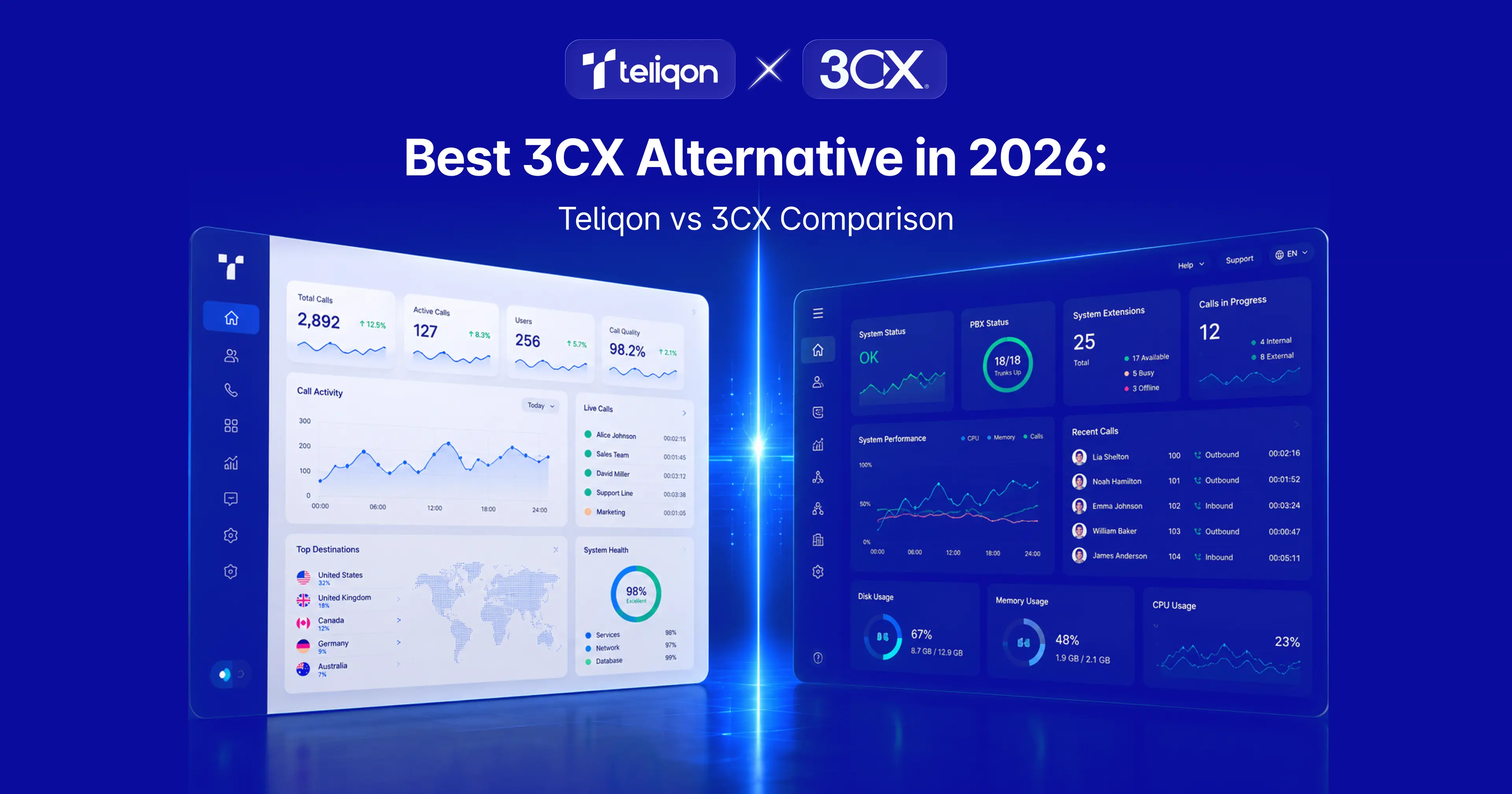
Is Teliqon a Good Alternative to 3CX?
Yes. For many organizations, Teliqon is an effective alternative to 3CX. It offers Cloud PBX, virtual numbers, Auto Dialer, SMS, omnichannel communication, and CRM-integrated telephony in a fully managed cloud environment, removing the need for internal PBX maintenance.
3CX remains a popular choice for businesses seeking self-hosted PBX deployment, advanced communication control, SIP flexibility, and predictable concurrent-call licensing supported by internal IT teams.
This guide offers an objective comparison of both platforms, evaluating deployment architecture, costs, features, and practical business scenarios to help decision-makers choose the solution that best fits their needs.
Quick Comparison
Why Trust This Comparison?
This comparison was prepared by professionals working in cloud communications, business telephony, SIP infrastructure, virtual numbers, contact center technologies, and customer communication workflows.
The analysis is based on a combination of publicly available information and industry experience, including:
-
official vendor documentation and product specifications from 3CX and Teliqon
-
pricing pages, licensing documentation, and total cost of ownership analysis
-
feature comparisons across UCaaS, CCaaS, and software PBX platforms
-
analyst research from Gartner, IDC, Frost & Sullivan, Omdia, Metrigy, and Cavell Group
-
publicly available customer reviews from G2, Gartner Peer Insights, Capterra, and Software Advice
-
SIP infrastructure, on-premise PBX, and cloud migration scenarios from telecommunications deployments
Rather than promoting one platform over the other, this comparison acknowledges the genuine strengths of 3CX while identifying the specific scenarios where Teliqon's architecture provides a more practical fit.
Editorial Methodology
This comparison was researched and written by telecommunications and business communication specialists. The content was reviewed by Teliqon leadership with experience in cloud telephony, SIP infrastructure, international virtual numbers, contact center operations, and communication technology deployments. Research sources include official product documentation, vendor pricing pages, analyst reports from Gartner, IDC, Frost & Sullivan, Omdia, Metrigy, and Cavell Group, independent software review platforms, technical product specifications, and migration and deployment best practices. Information is reviewed periodically to reflect product updates, pricing changes, and new communication technologies.
How We Evaluated Both Platforms
To ensure objectivity, we assessed 3CX and Teliqon using criteria commonly prioritized by businesses. The analysis draws on official vendor documentation, industry research, and verified customer feedback.
Deployment flexibility — support for self-hosted, on-premise, private cloud, or fully managed cloud deployment, and required infrastructure management.
Telephony capabilities — core features including IVR, call queues, ring groups, call recording, voicemail, and routing options.
Virtual numbers — native availability, dependency on external providers, and international number coverage.
SIP architecture — support for SIP trunking, carrier independence, and deployment flexibility.
CRM integration — supported CRM systems, integration depth, automation features, and potential plan restrictions.
Auto Dialer — availability of Predictive, Progressive, and Power Dialing, including standalone deployment options.
Omnichannel communication — support for customer interactions via voice, SMS, WhatsApp, Messenger, and live chat.
Hospitality integrations — availability of PMS integrations and hospitality-focused communication features.
Total cost of ownership — overall costs beyond licensing, including hosting, support, SIP services, security, and operational overhead.
Scalability — how effectively the platform adapts to larger teams, international expansion, and growing communication demands.
Introduction: On-Premise PBX vs. Cloud Communications in 2026
The business telephony industry is evolving rapidly. Companies that built their communications around software PBX systems and SIP trunking are increasingly assessing whether modern cloud communication platforms can provide greater flexibility, scalability, and operational efficiency.
Since its launch in 2005, 3CX has become one of the most recognized software PBX platforms in the market. Its support for self-hosted, private cloud, cloud-hosted, and on-premise deployment models has made it a preferred solution for IT departments, VoIP partners, and managed service providers.
However, many businesses are now adopting cloud-managed communication platforms that combine telephony, virtual numbers, SMS, CRM integration, and omnichannel communication without the burden of infrastructure management.
Mordor Intelligence estimates that the UCaaS market will grow from approximately $56 billion in 2025 to $175 billion by 2030. Metrigy research similarly highlights the convergence of UCaaS, CCaaS, and CRM systems as a major enterprise trend through 2027. GetVoIP
Market Trends Driving the Shift from PBX to Cloud Communications
Businesses are evaluating alternatives to traditional PBX systems due to several industry-wide trends:
Remote and hybrid work. Employees increasingly expect access to communication tools from any location and device without relying on VPNs or complex configuration.
International expansion. Establishing local communication channels in new countries often requires virtual numbers that can be deployed quickly and managed centrally.
Omnichannel customer expectations. Customers interact through multiple channels, including voice, SMS, WhatsApp, and live chat, creating demand for integrated communication environments.
Outbound automation. Modern sales and support operations require advanced dialing functionality that is often unavailable within traditional PBX platforms.
AI and analytics. Communication technology decisions increasingly involve reporting, automation, and intelligence capabilities alongside traditional telephony features.
Reduced IT overhead. Businesses continue moving toward cloud services to reduce infrastructure management, maintenance responsibilities, and ongoing administrative workload.
What Is 3CX?
3CX is a unified business communications platform with key features including voice calling, video conferencing, live chat, mobile apps, and advanced contact center features. Custom Market Insights
3CX's license fees are determined by the number of simultaneous calls (SC) a system can handle rather than the number of users or extensions. The annual license cost is flat for each SC tier, and no per-user or per-extension fees are applied. Following the April 2026 licensing restructure, 3CX offers four tiers: Free (entry-level), Basic (standard PBX functionality), PRO (advanced call handling, queues, reporting, CRM integration), and AI Edition (everything in PRO plus AI Receptionist, AI Personal Assistant, AI Agents, and AI Transcription). SecretRingly
Self-hosted customers must manage several ancillary expenses beyond the base license: server and networking infrastructure, voice service purchased from a SIP trunk provider, SSL certificates, technical support tickets, and regular maintenance, security updates, backups, and disaster-recovery planning. Secret
3CX has received multiple recognitions from Capterra and Software Advice throughout 2025 and was featured among G2's Top 50 Customer Service Products in 2024. GetApp
What Businesses Like About 3CX
Understanding why 3CX remains popular is important when evaluating alternatives. The platform has built a loyal user base through flexible deployment options, competitive licensing, carrier independence, and a broad feature set that appeals to technical teams. (Info based on Sonary, Techmode and Nextiva, ExafolRingly resourses)
What Is Teliqon?
Teliqon is a reliable communication solutions provider offering SIP Trunking, DID numbers, Cloud PBX, SMS solutions, and other tools designed to enhance communication across customer support, sales, and marketing functions for businesses of all sizes. Capterra
Teliqon's Cloud PBX enables businesses to handle high call volumes efficiently, offering real-time analytics, call recordings, IVR systems, and seamless CRM integration. With access to 170+ countries and virtual numbers in over 100 countries, Teliqon ensures seamless global connectivity. Capterra
Teliqon is a Cloud PBX and VoIP system built for businesses that need scalable and efficient communication. The Auto Dialer improves connect rates by skipping unanswered calls, busy signals, and voicemails, helping teams focus on real conversations — increasing productivity and reducing manual dialing effort. Checkthat
Teliqon integrates with a wide range of business tools including HubSpot CRM, Salesforce, Zoho CRM, Odoo, Microsoft Teams, Microsoft Outlook, Facebook Messenger, WhatsApp, Zendesk, and Zoho Desk, among others. The platform supports phone support, 24/7 live support, and online support as part of the subscription. G2
Teliqon's key services include Cloud PBX, Virtual Phone Numbers (170+ countries), SIP Trunking, Bulk SMS, OTP SMS, SMPP connectivity, Auto Dialer (Predictive, Progressive, Power), CRM integrations, omnichannel communication, and hospitality PMS integrations with Oracle Opera, Micros Fidelio, TigerTMS, JDS, and EasyLynq.
What Businesses Like About Teliqon
Independent reviews, customer feedback, and case studies consistently identify several areas where Teliqon stands out. Across sources such as Capterra, G2, TrustRadius, Research.com, Checkthat, and The CX Lead.
Global Telecom Layer Included
A major differentiator for Teliqon is its integrated telecom infrastructure.
Virtual numbers, SIP services, and SMS capabilities are included directly within the platform rather than sourced through separate providers. This enables organizations to manage communications, numbering resources, and connectivity through a single vendor relationship.
For businesses expanding internationally, this model reduces the complexity of coordinating multiple carriers and telecom contracts.
Auto Dialer — Native and Standalone
Teliqon's Auto Dialer is designed to increase outbound efficiency by automatically bypassing calls that are unlikely to result in live conversations.
The ability to deploy the Auto Dialer independently of Cloud PBX services gives organizations additional flexibility when building outbound sales and support operations.
Customer feedback often highlights faster deployment, increased talk time, and improved dialing productivity.
Virtual Numbers in 170+ Countries
The platform offers access to local and international numbers in more than 170 countries.
Organizations use these numbers to establish local presence, improve answer rates, and support communication strategies across multiple markets. Virtual numbers integrate directly with the broader Teliqon communications ecosystem.
This centralized approach can simplify international expansion compared with environments that rely on multiple telecom providers.
Hospitality Integrations
Teliqon's hospitality integrations support a range of widely used property management systems, including Oracle Hospitality Opera, Micros Fidelio, TigerTMS, JDS, and EasyLynq.
These integrations enable communication workflows that are specifically designed for hotel operations and guest services.
For hospitality businesses, native connectivity can reduce implementation time and ongoing maintenance requirements.
Omnichannel Communication
The platform supports customer communication across voice, SMS, WhatsApp, Messenger, live chat, and email.
A centralized communication workspace helps teams maintain visibility into customer interactions while reducing the need for multiple disconnected applications.
Customer reviews frequently emphasize the importance of preserving conversation context across channels.
Cloud-Managed Operations
Teliqon removes many of the infrastructure responsibilities associated with traditional PBX deployments.
Businesses can focus on communication operations without managing servers, telecom contracts, backups, security certificates, or disaster recovery systems.
This model is particularly attractive for organizations that prefer vendor-managed communications infrastructure.
CRM Integration Without Tier Restrictions
Teliqon connects with leading CRM, customer service, and collaboration platforms, including HubSpot, Salesforce, Odoo, Microsoft Teams, Outlook, Zendesk, and Zoho products.
Organizations gain access to communication workflows and CRM functionality without being forced into higher licensing tiers.
Reliability and Support Included
The platform combines communications services, infrastructure management, and support within a single environment.
Customer feedback frequently references responsive support, platform stability, and predictable operating costs as important benefits.
Contact Center Ready
Teliqon includes the tools required to support inbound and outbound contact center operations.
Call routing, IVR, analytics, reporting, queue management, and dialing automation are available within one platform, helping businesses manage customer communications at scale.
Why Organizations Look for 3CX Alternatives
Despite its strengths, 3CX is not the ideal fit for every organization. Several structural characteristics lead businesses to evaluate cloud-based alternatives.
3CX Total Cost of Ownership
3CX uses a concurrent-call (SC) licensing model rather than per-user pricing. While this approach can generate significant savings for some organizations, licensing represents only one component of the overall cost of ownership.
License costs. For mid-sized organizations with approximately 100–500 employees, a 64 SC PRO license is often required to support typical call volumes. This tier is priced at approximately $2,495 per year and serves as the foundation of the deployment cost. Checkthat
Hosting costs. Self-hosted deployments require server infrastructure. Smaller installations can operate on low-cost virtual machines, but organizations remain responsible for operating system maintenance, security updates, monitoring, backup validation, and disaster recovery planning. Businesses that choose 3CX-managed hosting incur additional annual hosting expenses depending on deployment size. G2
SIP trunking costs. Calling services are purchased separately through external telecom providers. Depending on usage patterns and carrier selection, SIP trunking can become a significant recurring operational expense. Checkthat
No native Auto Dialer. 3CX does not include native Predictive, Progressive, or Power dialing. Organizations with outbound campaigns must integrate third-party dialers, adding cost and complexity.
Telecom services not included. Unlike cloud-native platforms, 3CX does not provide virtual numbers, SIP trunking, or SMS infrastructure directly. These must be sourced externally and coordinated separately per country.
Admin complexity for non-technical users. Capterra reviewers note that the setup system is quite complex for non-technical users and requires extensive documentation and multiple support sessions. Gartner Peer Insights reviewers note that major version upgrades occasionally require rechecking integrations and reconfiguring custom call flows, adding operational overhead. TechnavioFuture Market Insights
Who Should Choose 3CX?
3CX is particularly well suited to organizations that want greater control over their communications environment and have the technical expertise to manage it.
Businesses with dedicated IT teams and VoIP administrators can take advantage of 3CX's self-hosted model while managing server infrastructure, SIP trunk providers, security updates, monitoring, backups, and ongoing maintenance internally.
Organizations that already operate SIP trunks, IP phones, and established carrier relationships can add 3CX as the PBX layer without replacing existing telecom investments. This makes it attractive for companies that have already built a mature communications infrastructure.
The platform is also a strong choice for managed service providers and VoIP resellers. Its partner ecosystem, multi-tenant capabilities, and SC-based licensing model allow service providers to support multiple customers efficiently.
For mid-market organizations with available IT resources, 3CX's lower licensing costs can create substantial long-term savings. Many cloud-hosted deployments achieve cost recovery within 12–18 months.
Businesses with requirements for on-premise deployment, private cloud environments, data residency, network control, or compliance-driven hosting often find 3CX better aligned with those objectives.
Who Should Choose Teliqon?
Teliqon is aimed at organizations that prefer to consume communications as a managed cloud service rather than operate the underlying infrastructure themselves.
International companies can obtain local, mobile, and toll-free virtual numbers alongside global SIP connectivity through a single provider relationship, with availability across more than 170 countries.
Contact centers and outbound sales operations benefit from native Predictive, Progressive, and Power Dialing modes, together with Cloud PBX, CRM integrations, analytics, call queues, and reporting tools. Auto Dialer can also be implemented independently for outbound-only teams.
Organizations seeking to reduce operational complexity can eliminate server administration, SIP carrier management, SSL certificate maintenance, and backup planning by adopting a fully managed platform.
Remote and hybrid workforces can use browser-based WebRTC calling, mobile applications, and virtual extensions without requiring dedicated office hardware.
Teliqon is also well suited to hospitality organizations that rely on integrations with Oracle Hospitality Opera, Micros Fidelio, TigerTMS, JDS, and EasyLynq.
Potential Limitations of Teliqon
Teliqon is not the ideal solution for every use case.
Because the platform is fully cloud-managed, it does not offer on-premise or self-hosted deployment models. Organizations that require private cloud environments, internal hosting, or strict infrastructure ownership may find this limiting.
Businesses that require advanced SIP routing, carrier-level customization, or deep infrastructure control will generally find more flexibility in 3CX.
Companies that have already invested heavily in SIP trunk agreements, on-premise communications hardware, and internal teams trained on 3CX may face migration costs that reduce the financial benefits of switching platforms.
Video conferencing, webinars, and digital collaboration are not the primary focus of the platform, making dedicated UCaaS environments potentially more suitable for video-centric organizations.
Some G2 reviewers also note that the interface could be refined further and that users without telecom or dialer experience may encounter a learning curve during initial deployment, although customer support receives consistently positive feedback. Checkthat
Which Platform Fits Different Business Needs?
Best 3CX Alternative for Different Use Cases
Best 3CX Alternative for SMBs
For many SMBs, managing servers, SIP providers, backups, security updates, and telecommunications infrastructure can create additional operational burden.
Teliqon offers a fully managed communications environment that includes Cloud PBX, CRM integrations, virtual numbers, messaging services, and telecom connectivity without requiring internal infrastructure management.
Best 3CX Alternative for Contact Centers
Outbound contact centers often require Predictive, Progressive, and Power Dialing to maximize agent productivity. Since 3CX does not provide native dialing automation, organizations typically integrate external dialer platforms.
Teliqon combines outbound dialing, call routing, analytics, CRM integration, and Cloud PBX functionality within one platform, simplifying deployment and administration. The CX Lead
Best 3CX Alternative for Hospitality
Hospitality businesses frequently require integration between telephony and property management systems.
Teliqon supports Oracle Opera, Micros Fidelio, TigerTMS, JDS, and EasyLynq through native integrations designed specifically for hotel operations, guest services, and room management workflows.
Best 3CX Alternative for International Business
Organizations operating across multiple countries often need local phone numbers, centralized communications management, and simplified telecom administration.
Teliqon provides international virtual number coverage across more than 170 countries, allowing businesses to manage global communications through a single provider relationship. G2
How Teliqon and 3CX Compare to Other Alternatives
The business communications market offers several cloud alternatives to 3CX. This table provides a neutral overview of how the major platforms compare across the criteria most relevant to organizations evaluating a 3CX replacement.
This comparison is intended to provide market context, not to rank platforms. Each solution has strengths that align with specific business requirements. Organizations evaluating 3CX alternatives should assess deployment model, telecom service inclusion, and outbound capabilities based on their specific operational needs.
Total Cost of Ownership Comparison
One of the most common questions from organizations evaluating 3CX alternatives is: what does each platform actually cost when all components are included?
3CX Total Cost of Ownership
The concurrent-call licensing model is one of 3CX's most attractive features, particularly for organizations that do not have all employees on calls simultaneously. However, the license fee represents only part of the total investment required to operate the platform.
Licensing. Organizations typically select a license tier based on expected concurrent call volume rather than user count. This can significantly reduce licensing expenses compared with per-user subscription models. Checkthat
Infrastructure. Self-hosted deployments require server resources, whether on-premise or in the cloud. Businesses must also manage maintenance, monitoring, security, backups, and recovery procedures. G2
Telecom connectivity. Because 3CX relies on external SIP providers, organizations must budget separately for telecom services and carrier relationships. Checkthat
Support and maintenance. Technical assistance may involve additional costs through vendor support programs or implementation partners. We are VoIP
Security management. Organizations retain responsibility for protecting the environment against telecom-specific security risks and ensuring compliance with internal requirements. G2
Operational overhead. Internal IT time spent administering the platform can represent a significant long-term cost, particularly in larger or more complex deployments. G2
Realistic annual TCO — mid-market deployment:
For businesses with relatively low call concurrency and in-house VoIP expertise, 3CX can offer a favorable cost structure. The platform's licensing model may initially appear significantly less expensive than per-user cloud alternatives. However, the total cost picture should also include hosting, SIP connectivity, security management, backups, monitoring, and support services, which can narrow the pricing gap over time. Emitrr
Where 3CX performs best from a cost perspective: Partner-managed deployments often remain substantially less expensive than comparable UCaaS solutions. The concurrent-call licensing approach allows organizations to avoid paying for inactive users, while flexible hosting options can further reduce operational costs. CloudTalk
Teliqon Total Cost of Ownership
Teliqon's pricing approach differs from traditional PBX deployments by combining communications services and telecom infrastructure within a single platform.
Included services: Cloud PBX, virtual numbers, SIP connectivity, mobile and browser-based calling, CRM integrations, omnichannel communication capabilities, platform administration, and support.
Additional infrastructure typically not required: Servers, SIP carrier management, SSL certificates, backup solutions, security monitoring tools, and related maintenance resources.
Flexible deployment options. Businesses can activate individual services based on operational requirements. Auto Dialer, for example, can be deployed independently rather than as part of a larger communications package.
Simplified cost structure. By consolidating communications infrastructure and platform management, organizations can reduce the number of separate vendors and service contracts involved in their communications environment.
TCO Comparison Summary
3CX vs. Teliqon — Detailed Platform Comparison
Architecture Overview
The fundamental difference between 3CX and Teliqon lies in how communications infrastructure is delivered. 3CX operates as a software PBX platform. Organizations manage calling features such as IVR, call queues, extensions, voicemail, and video conferencing through the PBX, while telecom connectivity and phone numbers are sourced from external SIP providers. This model offers flexibility and carrier independence but requires additional coordination between the PBX and telecom vendors.
Teliqon delivers communications through a unified cloud platform. PBX services, virtual numbers, SIP connectivity, SMS, and omnichannel communication capabilities are integrated into a single environment, simplifying deployment and ongoing administration.
Overall Feature Summary
Virtual Number Comparison
Auto Dialer Comparison
Omnichannel Comparison
CRM Integration Comparison
Hospitality Comparison
Real Business Scenarios
Scenario 1: International Sales Expansion
Business challenge:
A sales team is expanding into several new countries and requires local communication capabilities without managing separate telecom vendors in each market.
Communication requirements:
Cloud telephony, virtual numbers, CRM integration, mobile access, reporting, and centralized management.
Potential solution:
A communications platform that provides local numbers, telephony, and CRM-connected workflows through a single provider.
Potential outcomes:
Reduced telecom administration, faster market entry, and improved visibility into sales communications.
Scenario 2: Omnichannel Customer Service
Business challenge:
Support agents handle customer inquiries across multiple channels but lack a unified view of conversations and customer history.
Communication requirements:
Voice, SMS, WhatsApp, Messenger, live chat, CRM integration, and analytics.
Potential solution:
An omnichannel communications environment that centralizes all customer interactions.
Potential outcomes:
Faster issue resolution, improved customer experiences, and streamlined support operations.
Scenario 3: Multi-Property Hospitality Operations
Business challenge:
A hospitality organization manages several hotels and needs to coordinate communications across guest services, housekeeping, and front desk teams.
Communication requirements:
PMS integration, room extensions, internal calling, centralized administration, and hotel communication workflows.
Potential solution:
A hospitality-focused communications platform with native integrations for leading PMS systems.
Potential outcomes:
Simplified management, better guest service coordination, and reduced administrative workload.
Scenario 4: High-Volume Outbound Campaigns
Business challenge:
Outbound teams spend excessive time manually dialing prospects and customers.
Communication requirements:
Dialing automation, CRM integration, campaign reporting, and agent performance tracking.
Potential solution:
A platform with native outbound dialing capabilities and integrated analytics.
Potential outcomes:
More productive agents, higher connect rates, and greater campaign efficiency.
Scenario Summary
Moving from 3CX to Teliqon
Step 1 — Review Your Current Setup
Create a complete inventory of users, phone numbers, SIP trunks, call flows, queues, routing rules, and third-party integrations. Understanding the existing environment is essential for a smooth migration.
Step 2 — Transfer Business Numbers
Port existing phone numbers to the new platform by providing carrier details and ownership documentation. Avoid cancelling current services until the transfer is fully completed.
Step 3 — Recreate Users and Departments
Set up users, extensions, departments, and communication workflows. Replicate support queues, sales routing, reception handling, and escalation processes where necessary.
Step 4 — Configure Telecom Services
Evaluate SIP providers, routing policies, and failover strategies. Depending on business requirements, organizations can keep existing telecom providers or move to integrated connectivity services.
Step 5 — Restore Integrations
Reconnect CRM systems, helpdesk software, ERP platforms, and collaboration tools. Test automation workflows and ensure customer information is synchronized correctly.
Step 6 — Prepare Employees
Train employees on the new communication tools and provide administrators with guidance on platform management, reporting, and configuration.
Step 7 — Test with a Pilot Group
Validate call quality, integrations, routing, and adoption with a small group before deploying the platform company-wide.
Step 8 — Launch the Platform
Move production traffic to the new environment, verify system performance, and confirm that users can access all required functionality.
Step 9 — Fine-Tune the Environment
Adjust routing logic, IVR menus, reporting dashboards, and communication workflows based on operational feedback and usage data.
Migration Timeline
How to Choose the Right 3CX Alternative
Teliqon may be the better fit if:
-
You need virtual numbers across multiple countries without coordinating separate telecom providers.
-
Outbound calling is a key part of your sales or customer engagement strategy.
-
You want standalone Auto Dialer functionality that can operate independently of a PBX deployment.
-
CRM integration is essential and you want access to telephony workflows without upgrading licensing tiers.
-
Your business operates hotels, resorts, or hospitality properties that rely on PMS integrations.
-
You prefer a cloud-managed platform that reduces operational and infrastructure responsibilities.
-
SMS messaging, verification services, and telecom APIs are important parts of your communications stack.
3CX may be the better fit if:
-
Your IT team prefers direct control over communications infrastructure.
-
Regulatory, compliance, or internal policies require self-hosted deployment options.
-
You want maximum flexibility when selecting SIP carriers and routing strategies.
-
You manage communications environments on behalf of multiple organizations.
-
Concurrent-call licensing provides a lower total cost of ownership for your business.
Expert Verdict
Choosing between 3CX and Teliqon depends largely on the organization's technical profile and operational requirements.
3CX is generally better suited for organizations with experienced IT or VoIP teams that need a flexible, cost-effective software PBX — particularly where on-premise deployment, infrastructure control, self-hosted environments, carrier independence, or existing SIP provider relationships are priorities. Its concurrent-call licensing model can deliver significant cost advantages for technically capable organizations that manage the total cost of ownership effectively.
Teliqon is often a strong fit for companies looking for a cloud-managed communications platform that includes telephony, virtual numbers, SMS, Auto Dialer, omnichannel communication, and CRM-connected workflows — without deploying or maintaining infrastructure. For businesses operating across multiple countries, running outbound campaigns, or serving hospitality clients, Teliqon addresses requirements that 3CX does not cover natively.
For organizations where the primary challenge is managing SIP infrastructure efficiently and controlling deployment architecture, 3CX remains a compelling choice. For organizations where the primary challenge is simplifying international telephony, automating outbound calling, and centralizing customer communication across channels, Teliqon represents a practical and scalable cloud alternative.
Sources & Methodology
Tier 1 — Primary Sources
-
3CX Official Product Documentation and Pricing Pages
-
3CX Pricing Update Announcement (January 2026)
-
Teliqon Official Documentation and Product Pages
-
Gartner Peer Insights — 3CX Reviews
-
Omdia — Customer Engagement Platforms Research 2025
-
Mordor Intelligence — UCaaS Market Report
-
IDC — Cloud Communications and UCaaS Research
-
Frost & Sullivan — Cloud Telephony and Contact Center Market Analysis
-
Metrigy — UCaaS and Contact Center Research
Tier 2 — Independent Review and Research Sources
-
G2 — 3CX Reviews and Grid Reports (530+ verified reviews)
-
G2 — Teliqon Reviews
-
Capterra — 3CX Reviews (4.4 overall, 465 reviews)
-
Gartner Peer Insights — 3CX Reviews
-
Software Advice — 3CX and Teliqon Reviews
-
SourceForge — Teliqon Product Profile
-
Cavell Group — Cloud Communications Market Analysis
-
UC Today — UCaaS Market Analysis
All information was reviewed and updated in July 2026.
References
3CX Official Sources
3CX Official Website: https://www.3cx.com
3CX Pricing Page: https://www.3cx.com/ordering/pricing/
3CX January 2026 Pricing Update: https://www.3cx.com/blog/news/pricing-changes-2026/
3CX Reviews and Awards: https://www.3cx.com/phone-system/reviews/
Teliqon Official Sources
Teliqon Documentation: https://docs.teliqon.io/
Teliqon Cloud PBX: https://teliqon.io/cloud-pbx
Teliqon Omnichannel: https://teliqon.io/cloud-pbx/omnichannel
Teliqon Migration: https://teliqon.io/cloud-pbx/migrate-to-teliqon
3CX TCO and Pricing Analysis
3CX Pricing 2026 — CheckThat.ai: https://checkthat.ai/brands/3cx/pricing
Self-Hosting 3CX — Techmode: https://www.techmode.com/self-hosting-3cx-the-complete-cost-breakdown/
3CX Phone System Costs 2026 — We Are VoIP: https://wearevoip.us/3cx-phone-system-costs-in-2026-licenses-hosting-and-phones/
CloudTalk — 3CX Pricing Guide: https://www.cloudtalk.io/blog/3cx-pricing/
Nextiva — 3CX Pricing Guide: https://www.nextiva.com/blog/3cx-pricing.html
3CX User Reviews
G2 — 3CX Reviews: https://www.g2.com/products/3cx/reviews
G2 — Teliqon Reviews: https://www.g2.com/products/teliqon/reviews
Capterra — 3CX Reviews: https://www.capterra.com/p/158704/3CX/reviews/
Gartner Peer Insights — 3CX: https://www.gartner.com/reviews/market/unified-communications-as-a-service/vendor/3cx/product/3cx
Software Advice — Teliqon: https://www.softwareadvice.com/product/506022-TELIQON/
SourceForge — Teliqon: https://sourceforge.net/software/product/Teliqon/
UCaaS Market Research
Mordor Intelligence — UCaaS Market: https://www.mordorintelligence.com/industry-reports/unified-communication-as-a-service-ucaas-market
Fortune Business Insights — UCaaS Market: https://www.fortunebusinessinsights.com/industry-reports/unified-communication-as-a-service-ucaas-market-101934
Omdia — Customer Engagement Platforms 2025: https://omdia.tech.informa.com/om121537/omdia-universe-customer-engagement-platforms-2025
IDC — Cloud Communications Research: https://www.idc.com
Frost & Sullivan — Cloud Communications: https://www.frost.com
Metrigy — UCaaS Research: https://metrigy.com
Cavell Group — Cloud Communications Market Analysis: https://www.cavellgroup.com
Serhiy Bohush

Follow Us in social networks


The latest from Teliqon
Stay ahead with insights from the leader in trusted communications. Subscribe for the latest blogs, updates, and exclusive content.