



Dmytro Honcharenko
Interview with Dmytro Honcharenko, Co-Founder at Teliqon.
Q: Where do outbound teams actually lose the most time?
Many teams believe the issue is low activity, but the real problem is the time lost between calls. Agents have to dial manually, wait for responses, deal with voicemails, and jump between different systems.
This is backed by data. The Salesforce State of Sales report shows that reps spend just 28 to 30 percent of their week on real selling. The rest is taken up by admin tasks, switching between tools, and waiting—not actual conversations.
These small delays add up fast and cut down the time reps spend talking to prospects.
What does an auto dialer change in that workflow?
An auto dialer gets rid of those gaps. It handles dialing, moves through contact lists automatically, and filters out calls that won’t connect.
Instead of making agents wait, the system connects them only when a real person picks up or sends the call through IVR if needed. This keeps things moving smoothly and cuts out delays.
How does it work in practice during a campaign?
Well, in practice, the process is simple and easy to manage.
Firstly, teams begin by uploading or syncing their customer database, including phone numbers and other details, into the system.
Then they set up the campaign by choosing the dialing mode, setting call rules, and deciding how to handle outcomes such as no answer, busy signals, or voicemail.
Once the campaign starts, the system automatically dials through the list, connects answered calls to agents, and skips unproductive attempts. It can also trigger follow-ups, such as
voicemail or IVR messages, when needed. During calls, teams can collect basic feedback through predefined options or short prompts, helping them understand customer responses without slowing agents down.
At the same time, all interactions are logged and structured for analysis. Managers can track campaign performance in real time — including connection rates and outcomes — and adjust the process if needed. When the campaign ends, the team reviews results and refines the setup for the next run.
As shown below, with Teliqon, you can track agent performance in real time — including answered and missed calls, waiting time, and talking time — all in one dashboard:
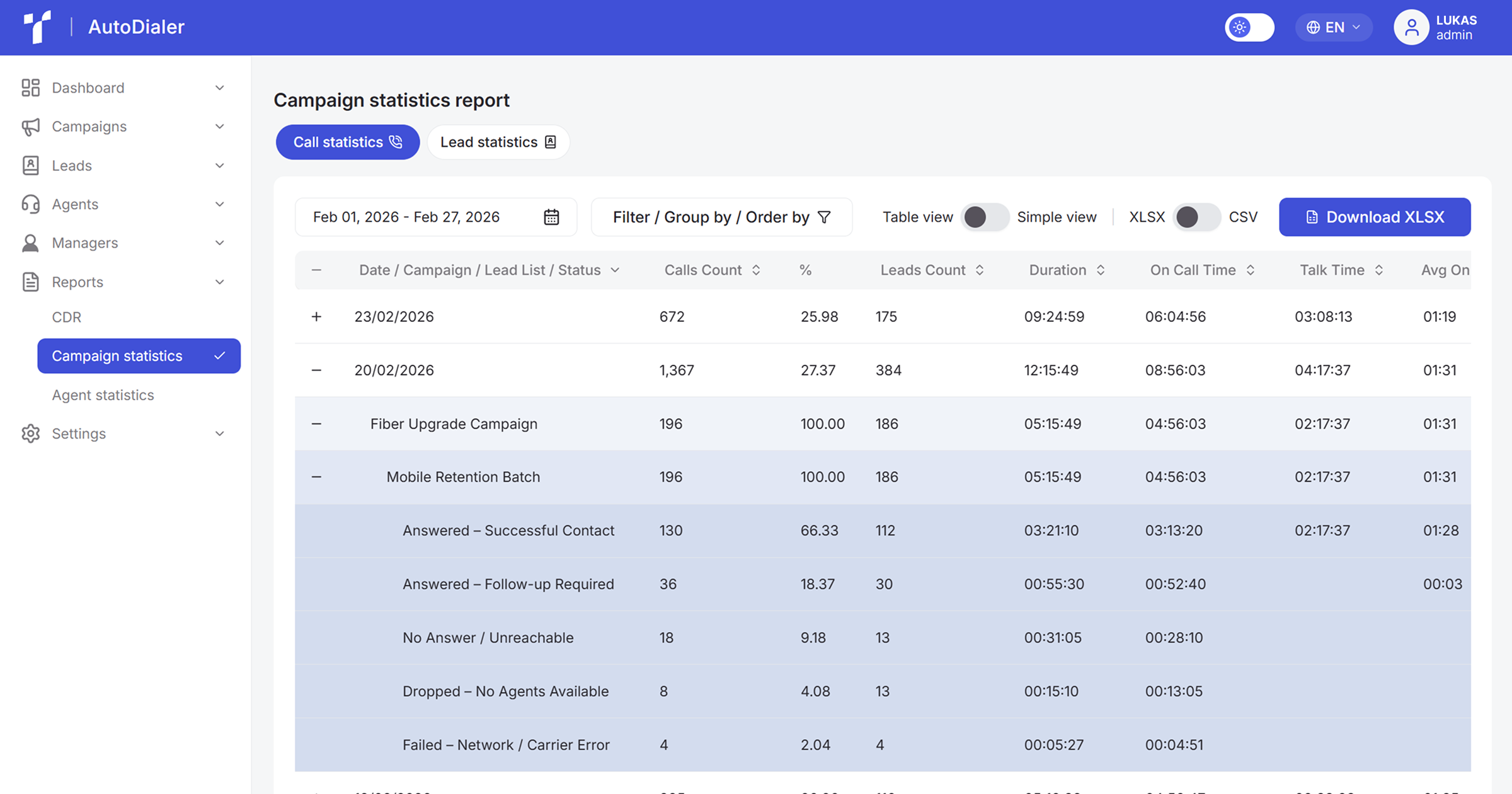
Using auto dialer software with call recording and analytics, you receive a roadmap for further campaigns, considering all factors. Nothing is missing.
How do teams scale outreach without hiring more agents?
It’s about working smarter, not harder. When agents spend less time dialing, waiting, or switching tools, they naturally handle more conversations per day.
Auto dialers increase productivity, improve call quality, and cut down on manual errors. They also centralize data, so teams can track performance and tweak campaigns based on real results. This helps agents save hours of unproductive time every day.
One of our B2B distribution clients reduced manual dialing by switching to automated campaigns. As a result, each agent could realistically complete around 60–80 calls per day.
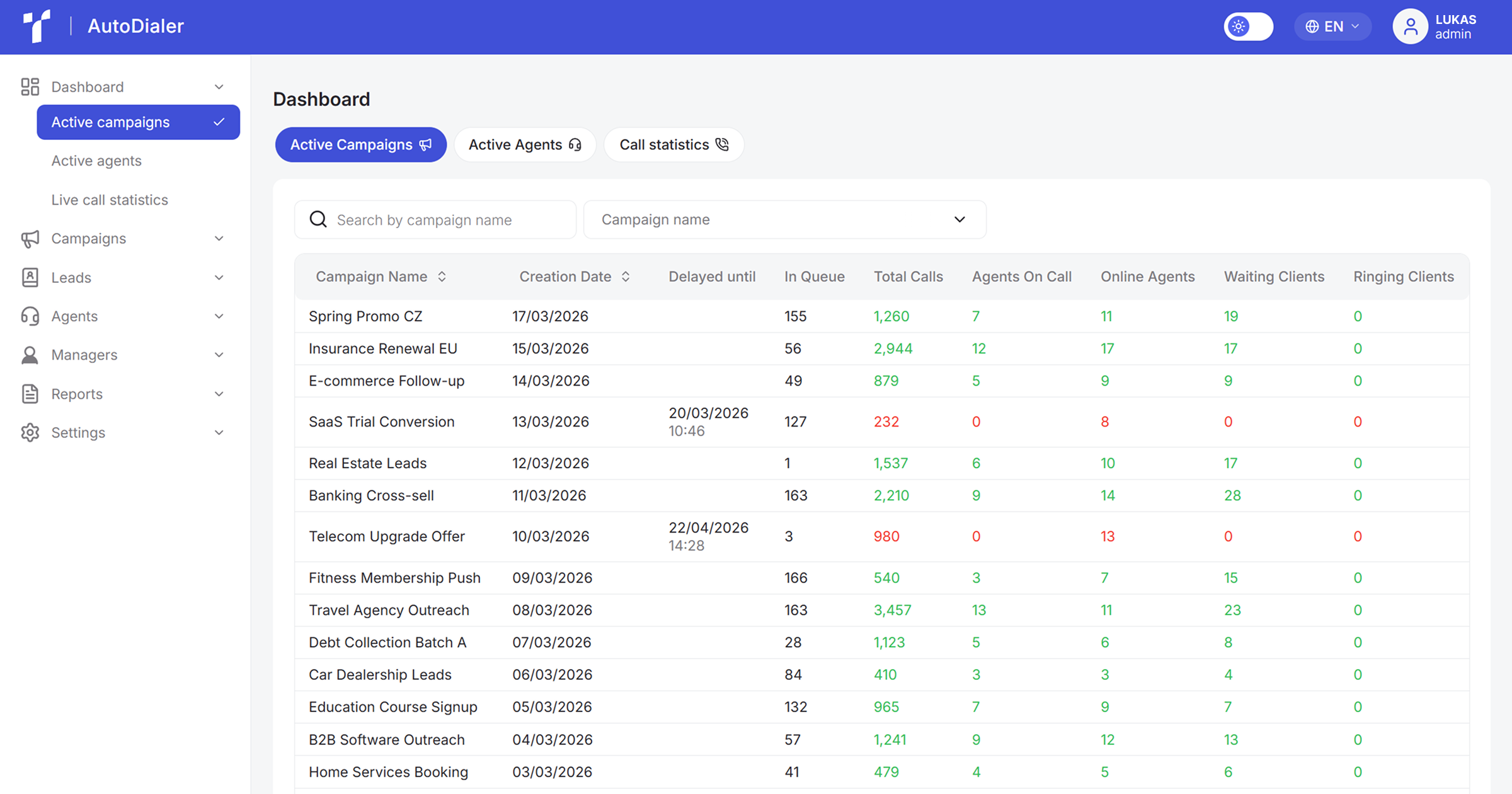
After implementing an auto dialer, the workflow changed completely. The system automatically filtered out unanswered calls, busy signals, and voicemails, connecting agents only when a real person picked up.
This shift increased productive talk time and reduced idle time. As a result, daily call volume per agent increased by approximately 40–70%, without hiring additional staff.
How should teams choose the right type of dialer?
It really depends on your business needs and the types of conversations your team handles. There’s no one-size-fits-all option.
Preview dialers are most effective when prioritizing quality over volume. They allow agents to review customer details before calling, facilitating complex or high-value interactions.
Progressive dialers strike a balance between efficiency and control by automatically advancing through contact lists, reducing idle time and maintaining a manageable call flow.
Outbound IVR dialers are suitable for automated campaigns, including reminders, updates, or surveys, where live-agent participation is not always necessary.
In the example we discussed earlier, the company used an outbound dialer.
What about compliance when scaling outbound calls?
Teams often overlook compliance initially, but as call volume increases, so does the risk of violating local regulations.
Modern dialers manage compliance by controlling call timing, pacing, and opt-out handling. This ensures campaigns comply with local rules without extra manual effort.
Why is a dialer alone no longer enough?
Today, communication doesn’t happen through a single channel. A call often leads to a follow-up SMS, a CRM update, or another touchpoint. When these tools are disconnected, teams lose context and spend time switching between systems. Most business leaders run into the same frustration sooner or later.
That’s why modern outbound operations require a unified approach.
This is how we created Teliqon — not just as a single service provider, but a communication hub built to solve real operational challenges.
It combines auto dialing, Cloud PBX, global virtual numbers, SMS, and real-time analytics so sales, marketing, and support teams can manage everything from a single platform.
If questions are already coming to mind, the Teliqon team will be glad to walk you through them. You can request a demo or book a consultation to see how Teliqon Cloud call center solutions fit into your specific workflow.
Dmytro Honcharenko

Follow Us in social networks


The latest from Teliqon
Stay ahead with insights from the leader in trusted communications. Subscribe for the latest blogs, updates, and exclusive content.