



Serhiy Bohush
July 1, 2026
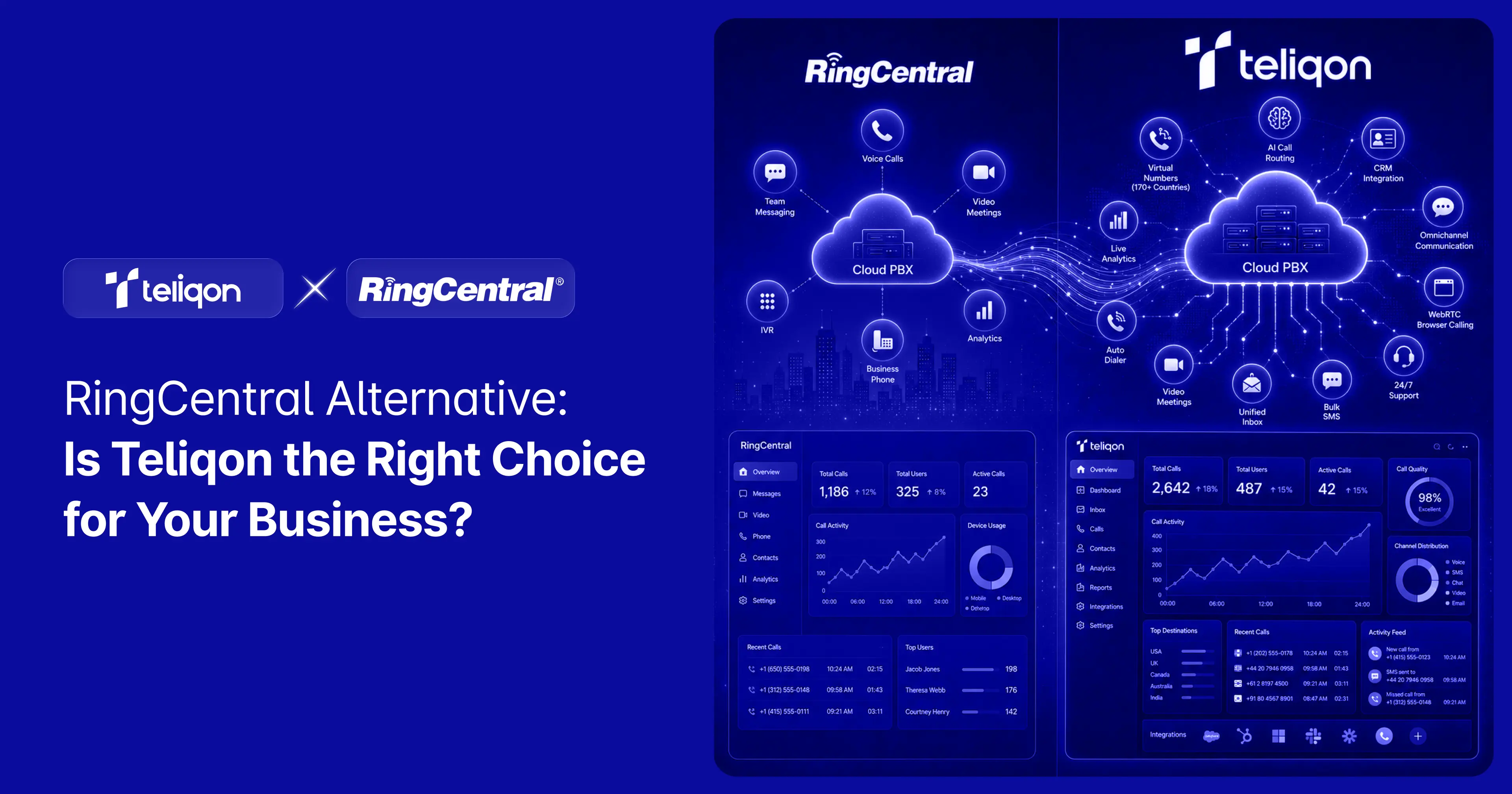
RingCentral Alternative: Is Teliqon the Right Choice for Your Business?
This comparison was developed by industry professionals with expertise in cloud communications, business telephony systems, SIP infrastructure, virtual numbers, contact center platforms, and customer communication processes.
The findings draw upon both publicly accessible information and practical industry experience, including the following sources:
-
official vendor materials and product documentation
-
pricing information and subscription models
-
comparative analysis of UCaaS and CCaaS capabilities
-
industry research from Gartner, IDC, Frost & Sullivan, Omdia, Metrigy, and Cavell Group
-
publicly available user reviews from G2, Gartner Peer Insights, Software Advice, and Capterra
-
migration scenarios regularly encountered in cloud telephony projects
-
Customer Relationship Management (CRM), Application Programming Interface (API), Session Initiation Protocol (SIP), and omnichannel communication requirements commonly evaluated during platform selection
Instead of relying solely on vendor claims, this guide evaluates how each solution addresses operational challenges, including international communications, cloud telephony adoption, CRM integration, outbound calling strategies, omnichannel engagement, scalability, and deployment considerations.
Given the variability of business communication requirements, no single platform is universally ideal. This comparison aims to provide decision-makers with a clear understanding of the respective strengths of RingCentral and Teliqon, enabling informed selection based on specific operational needs.
Editorial Methodology
Telecommunications and business communication experts developed this comparison. Teliqon leadership, with hands-on experience in cloud telephony, SIP infrastructure, international virtual numbering, contact center workflows, and communication technology deployments, reviewed the content.
Research sources include official product materials, vendor pricing documentation, analyst research published by Gartner, IDC, Frost & Sullivan, Omdia, Metrigy, and Cavell Group, independent software review sites, technical product documentation, and industry-recognized migration and deployment best practices. The information is reviewed periodically to ensure accuracy and to reflect product updates, pricing adjustments, and advancements in communication technology.
Introduction: The Business Communication Landscape in 2026
Business communication has fundamentally changed. The era of on-premise phone systems is giving way to cloud-native platforms that connect voice, messaging, video, and customer interaction in a single environment — accessible from any device, in any country, without hardware investment.
Two categories of platforms now dominate enterprise communication purchasing decisions:
UCaaS (Unified Communications as a Service) is a cloud-based model that combines enterprise telephony, video conferencing, instant messaging, file sharing, and basic contact center functions under a single subscription. UCaaS enables businesses to centralize their entire communication architecture and provide access to a variety of turnkey applications and services without the need to invest in IT hardware or specialized support teams. According to Fortune Business Insights, the global UCaaS market was valued at approximately $66 billion in 2025 and is projected to reach $276 billion by 2034, growing at a CAGR of over 17%. ¹ IDC and Frost & Sullivan research similarly identifies cloud telephony and contact center convergence as one of the defining technology investment trends for enterprises through 2027. ²
CCaaS (Contact Center as a Service) extends UCaaS with customer-facing capabilities — call queues, IVR menus, agent dashboards, omnichannel routing, Auto Dialer functionality, and real-time analytics designed specifically for inbound and outbound customer operations.
According to Metrigy research, the boundary between UCaaS and CCaaS is increasingly blurred — customers do not distinguish between whether an interaction belongs to a collaboration platform, a contact center suite, a CRM, or a helpdesk tool. They expect the business to know who they are and respond quickly, regardless of which system handles the interaction. ³ Cavell Group further notes that cloud communications adoption among SMBs and mid-market organizations is accelerating as organizations move away from fragmented, on-premise deployments toward integrated cloud platforms. ⁴
RingCentral is one of the most established names in this market. According to Synergy Research Group, the worldwide UCaaS subscriber base exceeded 120 million seats in mid-2025, with Microsoft Teams, Zoom, and RingCentral collectively commanding the majority of enterprise deployments. ⁵ For many organizations, however, the breadth of RingCentral's platform — and the complexity and cost that come with it — raises the question of whether a more focused alternative might be a better fit.
When do businesses start looking for a RingCentral alternative?
The most common scenarios include:
-
International virtual numbers are needed in regions where RingCentral is not widely available.
-
Contract terms and pricing have become less suitable for current business needs.
-
The organization needs outbound calling and Auto Dialer capabilities without the cost of a full enterprise contact center suite.
-
CRM integration is important, but the business does not need a broad collaboration platform.
-
Global growth requires communication tools that support operations across multiple countries.
-
Limited IT capacity makes simple deployment and administration a higher priority.
What criteria matter most when evaluating alternatives?
-
Number of supported countries for virtual numbers and SIP connectivity
-
Flexibility of the pricing model (modular vs. bundled)
-
Ease of CRM integration and API access
-
Availability of omnichannel tools (SMS, WhatsApp, Messenger, chat)
-
Auto Dialer capabilities and dialing modes
-
Contract terms and deployment timeline
-
Support for remote and browser-based calling without hardware requirements
-
Industry-specific features (hospitality, fintech, outsourcing, SaaS)
This article examines RingCentral and Teliqon across all of these dimensions, provides a structured migration guide, and lists the best RingCentral alternatives on the market today.
What Is RingCentral?
What Is RingCentral?
RingCentral is a cloud UCaaS, CCaaS, and video conferencing provider serving over 400,000 customers globally. ⁶ The platform has been recognized as a Gartner Magic Quadrant Leader for UCaaS eleven consecutive years as of 2025. ⁷ Its scalable solution gives remote and in-house teams access to a business phone system, a CX-focused contact center, webinar and video conferencing applications, and AI-powered analytics and sales tools.
RingCentral's main business phone plans are Core (from $20/user/month), Advanced (from $25/user/month), and Ultra (from $35/user/month), billed annually, with separate, often quote-based pricing for Contact Center and AI add-on products. ⁸
Why Companies Look for RingCentral Alternatives
Despite its strengths, RingCentral is not the ideal fit for every organization. There are several structural reasons why businesses actively search for alternatives.
Pricing complexity and hidden costs. Between strict SMS limits, expensive AI add-ons, and compliance fees, the final bill can look quite different from the advertised rate. Businesses need to purchase the Advanced plan to access features like call recording or HubSpot integration, even if they do not need the other features bundled into that tier. ⁹
Contract rigidity and deployment complexity. G2 and Gartner Peer Insights reviews consistently note that some organizations experience difficulty modifying or exiting long-term contracts, and that the platform's depth of configuration can require dedicated IT resources to manage effectively. ¹⁰
Enterprise complexity for SMB needs. RingCentral is engineered for large organizations with mature IT teams. Businesses that primarily need cloud telephony, virtual numbers, and CRM-connected workflows often find that they are paying for collaboration and video features they do not use.
International coverage limitations. For businesses that need local virtual numbers across multiple countries, RingCentral's geographic availability may not meet requirements without significant configuration overhead and additional cost.
Support experience. G2 and Capterra reviews note that some enterprise users find support navigation difficult and report inconsistent responsiveness from account teams, particularly during complex multi-country deployments. ¹¹
Who Should Choose RingCentral?
RingCentral remains one of the most capable UCaaS platforms on the market for the right buyer profile.
Enterprise organizations with large IT teams, dedicated communication administrators, and complex organizational structures benefit from RingCentral's depth of feature configuration and enterprise-grade compliance tools.
AI-powered contact centers that need advanced AI conversation intelligence, real-time transcription, sentiment analysis, and meeting summaries delivered natively within the platform will find RingCentral's AI ecosystem mature and well-integrated.
Collaboration-heavy teams that rely on video conferencing, webinars, whiteboarding, and asynchronous team messaging as core daily tools — and want all of this within a single vendor — will find RingCentral's suite coherent and well-designed.
Large corporate environments operating in English-speaking markets with established procurement processes, volume licensing negotiations, and multi-year roadmap planning will find RingCentral a reliable strategic partner.
Who Should Choose Teliqon?
Teliqon is a cloud-based business communication platform that combines Cloud PBX, virtual phone numbers, Auto Dialer, and Bulk SMS messaging into a single scalable solution. It enables businesses to manage inbound and outbound calls, automate sales campaigns with predictive dialing, and send SMS notifications or marketing messages globally. The platform supports CRM integrations, allowing teams to synchronize customer data, track interactions, and optimize workflows in real time. ¹²
International businesses operating across multiple countries that need local virtual numbers and global SIP connectivity without complex configuration will find Teliqon specifically designed for this use case, with coverage across more than 170 countries.
Call centers and outbound sales teams that need Predictive, Progressive, and Power dialing modes — deployable without requiring a full Cloud PBX subscription — will benefit from Teliqon's modular approach to Auto Dialer functionality.
Remote and distributed teams that need browser-based WebRTC calling, mobile access, and virtual extensions without hardware investment will find Teliqon quick to deploy and easy to manage.
Companies requiring virtual numbers in specific countries for local presence, inbound routing, or customer trust purposes will find Teliqon's portfolio across 170+ countries a significant operational advantage.
Which Platform Fits Different Business Needs?
Best RingCentral Alternatives
1. Teliqon
Best for: International telephony, cloud PBX, Auto Dialer, omnichannel communication, virtual numbers in 170+ countries
Teliqon's Cloud PBX enables businesses to handle high call volumes efficiently, offering real-time analytics, call recordings, IVR systems, and seamless CRM integration. With access to 170+ countries and virtual numbers in over 100 countries, Teliqon ensures seamless global connectivity. Its modular structure allows businesses to use Auto Dialer, SMS, or virtual numbers independently without requiring a full PBX subscription — a meaningful advantage for organizations that want to scale specific communication capabilities without purchasing a complete enterprise suite.
2. 8x8
Best for: Enterprise UCaaS with advanced analytics and contact center depth
Among enterprise-focused communication platforms, 8x8 stands out for its combination of unified communications and contact center capabilities. It is well suited to organizations with high call volumes that need advanced analytics, AI tools, and support for multiple communication channels. The UCaaS suite includes voice calling, video meetings, SMS, messaging applications, email, and team chat.
3. Vonage
Best for: Developer-friendly telephony, API customization, programmatic communication workflows
Vonage's unified communications solution integrates chat, calling, and meetings within a single application. It provides developer-friendly products for programmable voice, messaging, and SMS automation, making it ideal for businesses looking for customizable communication workflows. Its AI-powered contact center includes virtual agents, sentiment analysis, and omnichannel customer support.
4. Nextiva
Best for: SMB and mid-market organizations needing an all-in-one UCaaS and customer experience platform
Nextiva's AI-powered customer experience platform is designed to engage, market, sell, and service businesses across a variety of sectors. It offers voice, SMS, video, and collaboration tools, and helps teams manage customer interactions across the entire customer journey, with conversational analytics, inbound workflows, and app integrations.
5. Aircall
Best for: Fast-growing sales and support teams with strong CRM integration requirements
Aircall is particularly suited for fast-growing startups and sales teams. It offers plug-and-play setup with strong CRM integration and excellent support for remote teams. The platform provides phone numbers in 100+ countries, intelligent call routing, and deep integrations with CRM and helpdesk platforms.
6. 3CX
Best for: IT-managed environments, self-hosted deployments, cost-conscious businesses
3CX combines affordability with simple deployment and management. The platform includes call queues, built-in video calls, web conferencing, and the ability to connect website live chat, Facebook, and text messages through a single system. With both cloud-hosted and self-hosted deployment options available, it is a flexible choice for businesses that have in-house technical capabilities.
RingCentral vs. Teliqon — Detailed Comparison
Overall Feature Summary
Cloud PBX Comparison
Both solutions offer cloud-based PBX capabilities without requiring on-premise infrastructure. Teliqon's Cloud PBX serves businesses of all sizes, from small teams that need reliable call routing to large sales operations that rely on analytics, call recording, and centralized high-volume call management. Browser-based calling and device compatibility provide flexibility for distributed teams.
RingCentral combines PBX services with integrated video, messaging, and AI functionality, making it well suited for organizations seeking unified communications and collaboration tools. Teliqon centers on call management, CRM synchronization, and outbound performance optimization, making it better suited for businesses where customer interactions are a primary operational focus.
Virtual Number Comparison
Teliqon is designed to support global virtual number deployment across multiple markets. Customers report fast access to local numbers in countries such as the UK, Netherlands, Poland, Israel, and Ukraine. The ability to quickly establish local communication channels can improve client engagement and local response rates. For businesses operating internationally, this provides a practical way to build a local presence without setting up physical offices.
Auto Dialer Comparison
A notable feature of Teliqon is that Auto Dialer functionality can be deployed without subscribing to a full Cloud PBX solution. This approach is well suited to sales teams, outbound campaign activities, and businesses that need dialing capabilities as a separate tool. By offering a modular deployment model, Teliqon can reduce operational complexity and costs when compared with RingCentral's bundled Contact Center approach.
Omnichannel Comparison
RingCentral's omnichannel capabilities are delivered primarily through its Contact Center tier. Teliqon's omnichannel tools are available as part of its core communication platform, allowing businesses to manage voice, SMS, WhatsApp, Messenger, and live chat through a centralized interface without a separate CCaaS subscription.
CRM Integration Comparison
RingCentral restricts HubSpot and Salesforce integration to the Advanced plan and above, meaning businesses on the Core tier must upgrade to access CRM connectivity. Teliqon's CRM integrations — including Odoo, common in international and mid-market deployments — are available across the platform without tier restrictions.
Hospitality Comparison
Teliqon is one of the few cloud communication platforms with native hospitality integration capabilities. For hotel groups, resorts, and hospitality operators that rely on property management systems such as Oracle Opera or Micros Fidelio, Teliqon offers purpose-built connectivity that RingCentral does not provide.
Real Example: Migrating from RingCentral to Teliqon
Company: International organization with distributed sales and customer support teams serving multiple countries.
Problem: While using RingCentral for communications, the company identified new operational requirements that prompted a search for alternative platforms. These included local virtual numbers in several countries, more efficient outbound calling workflows, CRM-connected telephony, SMS and omnichannel communication, and browser-based access for remote teams. The business also wanted a solution that did not require a broad UCaaS suite with unnecessary features.
Solution: Prior to migration, the company carried out a comprehensive audit of its RingCentral deployment. The review covered active phone numbers, extensions, call routing, IVR menus, user accounts, devices, and CRM integrations. Number porting was managed separately to ensure continuity of customer communications and minimize operational disruption.
Teliqon was then introduced as the company's cloud communications environment, combining Cloud PBX, local virtual numbers, Auto Dialer, SMS services, CRM integration, and WebRTC browser-based calling. Before going live, inbound and outbound call flows, IVR configurations, and queue operations were fully tested.
Result:
-
The company centralized communication management across all operating countries in a single platform
-
Sales and support teams began using browser-based calling without on-premise hardware
-
Outbound teams received Auto Dialer functionality without deploying a full enterprise contact center suite
-
CRM-connected workflows improved visibility into customer interactions across the entire lifecycle
-
The business reduced dependence on multiple disconnected communication tools
Key takeaway: For companies that do not need a broad enterprise collaboration suite, migrating from RingCentral to Teliqon can help simplify international telephony, outbound calling, and CRM-connected customer communication.
Migration Guide: Switching from RingCentral to Teliqon
Stage 1 — Audit Your Current RingCentral Environment
Begin with a complete inventory of your RingCentral environment. Review all active phone numbers, extensions, departments, call queues, IVR menus, ring groups, call recording configurations, integrations, contact center processes, and user accounts.
Record all relevant details, including DID numbers, toll-free numbers, call forwarding rules, voicemail settings, employee information, departments, permissions, device assignments, CRM platforms, helpdesk tools, APIs, queue logic, agent groups, and reporting settings.
Stage 2 — Number Porting
Port all existing local, toll-free, and international business numbers from RingCentral to Teliqon. Common requirements include ownership verification, current service records, authorized contact information, and a recent telecom invoice.
For a smooth migration, keep services active until porting is completed and schedule number transfers outside normal peak operating hours.
Stage 3 — User Migration
Configure internal extensions and assign permissions for administrators, managers, agents, and standard users.
Connect browsers, mobile applications, IP phones, and softphones, and provide access to Cloud PBX, messaging services, virtual numbers, and omnichannel communication channels.
Stage 4 — CRM and Business System Integration
Review and rebuild CRM integrations where required. This includes reconnecting telephony systems, enabling click-to-call capabilities, restoring call logs, configuring workflow automation, and validating customer data synchronization.
Confirm proper integration with HubSpot, Salesforce, Zoho CRM, Odoo, Zendesk, Microsoft Teams, and Outlook.
Stage 5 — Testing and Validation
Test all communication workflows, including inbound and outbound calls, transfers, forwarding, IVR menus, call queues, CRM synchronization, SMS, WhatsApp, Messenger, and live chat. Complete User Acceptance Testing (UAT) before switching production traffic to the new environment.
Stage 6 — Go-Live and Optimization
Launch number routing and monitor call quality, queue performance, and operational metrics. Provide onboarding support and documentation while continuing to optimize IVR configurations, routing strategies, and reporting after deployment.
Migration Timeline
When RingCentral Is a Better Choice
RingCentral is often the preferred option for organizations seeking a comprehensive enterprise UCaaS platform with integrated video, meetings, team messaging, and AI tools. Its native AI features, such as real-time transcription, call summaries, and sentiment analysis, support advanced communication needs. The platform is designed for large-scale deployments, offering enterprise-grade controls, compliance support, and access to over 300 third-party integrations through a reliable support ecosystem.
When Teliqon Is a Better Choice
Teliqon is the stronger option when the business requires virtual phone numbers across a global footprint of 170+ markets; Auto Dialer functionality deployable as a standalone service without purchasing a full PBX subscription; cloud telephony, SMS, and omnichannel communication without the overhead of a large collaboration suite; faster deployment with flexible contract terms and modular service selection; CRM-connected telephony with Odoo, Zoho, HubSpot, or Salesforce from day one; hospitality-grade integrations with Oracle Opera, Micros Fidelio, or TigerTMS; or a customer-facing platform that prioritizes outbound calling, call center performance, and global reach over internal collaboration.
How to Choose the Right RingCentral Alternative
Not every RingCentral alternative serves the same business needs. The right platform depends on what your organization actually requires from its communication infrastructure — not on feature lists alone.
Choose Teliqon if:
-
Your business operates across multiple countries and needs local virtual numbers to establish a credible regional presence
-
Your sales or support teams run outbound calling campaigns and need Predictive, Progressive, or Power dialing modes
-
You want Auto Dialer functionality without committing to a full enterprise contact center subscription
-
Your CRM workflows — whether in HubSpot, Salesforce, Zoho, or Odoo — need to be tightly connected to your telephony from day one
-
You operate in the hospitality sector and rely on property management systems such as Oracle Opera or Micros Fidelio
-
Your agents work remotely or in distributed locations and need browser-based WebRTC calling without hardware
Choose RingCentral if:
-
Internal team collaboration, video meetings, and asynchronous messaging are as important as customer-facing communication
-
You need native AI features — real-time transcription, sentiment analysis, meeting summaries, and AI-powered coaching — embedded directly in the platform
-
Your organization requires enterprise governance, compliance controls, and audit capabilities at scale
-
You are deploying a large, centralized communication environment across thousands of users with dedicated IT support
If you are unsure, the most useful question to ask is: does your primary communication challenge involve reaching customers across multiple countries, running outbound campaigns, or simplifying CRM-connected telephony? If yes, Teliqon is likely the better fit. If the challenge is consolidating internal collaboration, meetings, and AI productivity tools across a large enterprise, RingCentral is likely the stronger choice.
Sources & Methodology
This comparison is based on:
Tier 1 — Primary Sources
-
Official RingCentral product documentation, pricing pages, and developer platform
-
Gartner Magic Quadrant for UCaaS (2025)
-
Gartner Peer Insights — RingEX Reviews
-
Omdia — Customer Engagement Platforms Research 2025
-
Fortune Business Insights — UCaaS Market Report
-
Synergy Research Group — UCaaS Subscriber Base Data
-
IDC — Cloud Communications and UCaaS Research
-
Frost & Sullivan — Cloud Telephony and Contact Center Market Analysis
Tier 2 — Independent Review and Research Sources
-
G2 — RingCentral MVP Reviews and Grid Reports
-
G2 — Momentum Reports, UCaaS Category
-
Software Advice — RingCentral Reviews
-
Capterra — RingCentral and Cloud PBX Reviews
-
SourceForge — Teliqon Product Profile
-
Metrigy — UCaaS and Contact Center Research
-
Cavell Group — Cloud Communications Market Analysis
-
UC Today — UCaaS Market 2025 Analysis
-
Mordor Intelligence — UCaaS Market Report
Teliqon Sources
-
Teliqon Official Documentation: https://docs.teliqon.io/
-
Teliqon Product Pages: https://teliqon.io/
-
Teliqon API Documentation: https://docs.teliqon.io/
All information was reviewed and updated in July 2026.
References
¹ UCaaS Market Size and Growth Forecast Fortune Business Insights — Unified Communication as a Service Market https://www.fortunebusinessinsights.com/industry-reports/unified-communication-as-a-service-ucaas-market-101934
Future Market Insights — UCaaS Market Report https://www.futuremarketinsights.com/reports/unified-communication-as-a-service-ucaas-market
² Cloud Telephony and Contact Center Convergence IDC — Cloud Communications Research https://www.idc.com
Frost & Sullivan — Cloud Contact Center and UCaaS Market Analysis https://www.frost.com
³ UCaaS and CCaaS Boundary Convergence Metrigy — UCaaS and Contact Center Research https://metrigy.com
⁴ Cloud Communications Adoption Trends Cavell Group — Cloud Communications Market Analysis https://www.cavellgroup.com
⁵ UCaaS Subscriber Base — Synergy Research Group Referenced via Future Market Insights UCaaS Market Report https://www.futuremarketinsights.com/reports/unified-communication-as-a-service-ucaas-market
⁶ RingCentral — Company Overview and Customer Base RingCentral — What is RingCentral? https://www.ringcentral.com/us/en/blog/what-is-ringcentral/
⁷ Gartner Magic Quadrant for UCaaS RingCentral — 2025 Gartner Magic Quadrant https://www.ringcentral.com/lp/gartner-magic-quadrant.html UC Today — UCaaS Market 2025 Gartner Magic Quadrant Analysis https://www.uctoday.com/unified-communications/ucaas-market-2025-gartner-magic-quadrant-highlights-leaders-and-emerging-trends/
⁸ RingCentral Pricing RingCentral — Plans and Pricing https://www.ringcentral.com/office/plansandpricing.html
⁹ RingCentral Plan Restrictions and Feature Bundling RingCentral Pricing Page — feature tier analysis https://www.ringcentral.com/office/plansandpricing.html G2 — RingCentral MVP Reviews https://www.g2.com/products/ringcentral-mvp/reviews
¹⁰ RingCentral Contract Experience G2 — RingCentral MVP Reviews https://www.g2.com/products/ringcentral-mvp/reviews Gartner Peer Insights — RingEX Reviews https://www.gartner.com/reviews/market/unified-communications-as-a-service/vendor/ringcentral/product/ringex
¹¹ RingCentral Support Feedback G2 — RingCentral MVP Reviews https://www.g2.com/products/ringcentral-mvp/reviews
Capterra — RingCentral Reviews https://www.capterra.com/p/61827/RingCentral/
¹² Teliqon Product Overview Teliqon Official Documentation: https://docs.teliqon.io/
Teliqon Product Pages: https://teliqon.io/
Additional Market Research Omdia — Customer Engagement Platforms 2025 https://omdia.tech.informa.com/om121537/omdia-universe-customer-engagement-platforms-2025
Mordor Intelligence — UCaaS Market https://www.mordorintelligence.com/industry-reports/unified-communication-as-a-service-ucaas-market
Software Advice — RingCentral Reviews https://www.softwareadvice.com/voip/ringcentral-profile/
SourceForge — Teliqon Profile https://sourceforge.net/software/product/Teliqon/
Serhiy Bohush

Follow Us in social networks


The latest from Teliqon
Stay ahead with insights from the leader in trusted communications. Subscribe for the latest blogs, updates, and exclusive content.