



Arthur Kyselevskyi
November 23, 2026
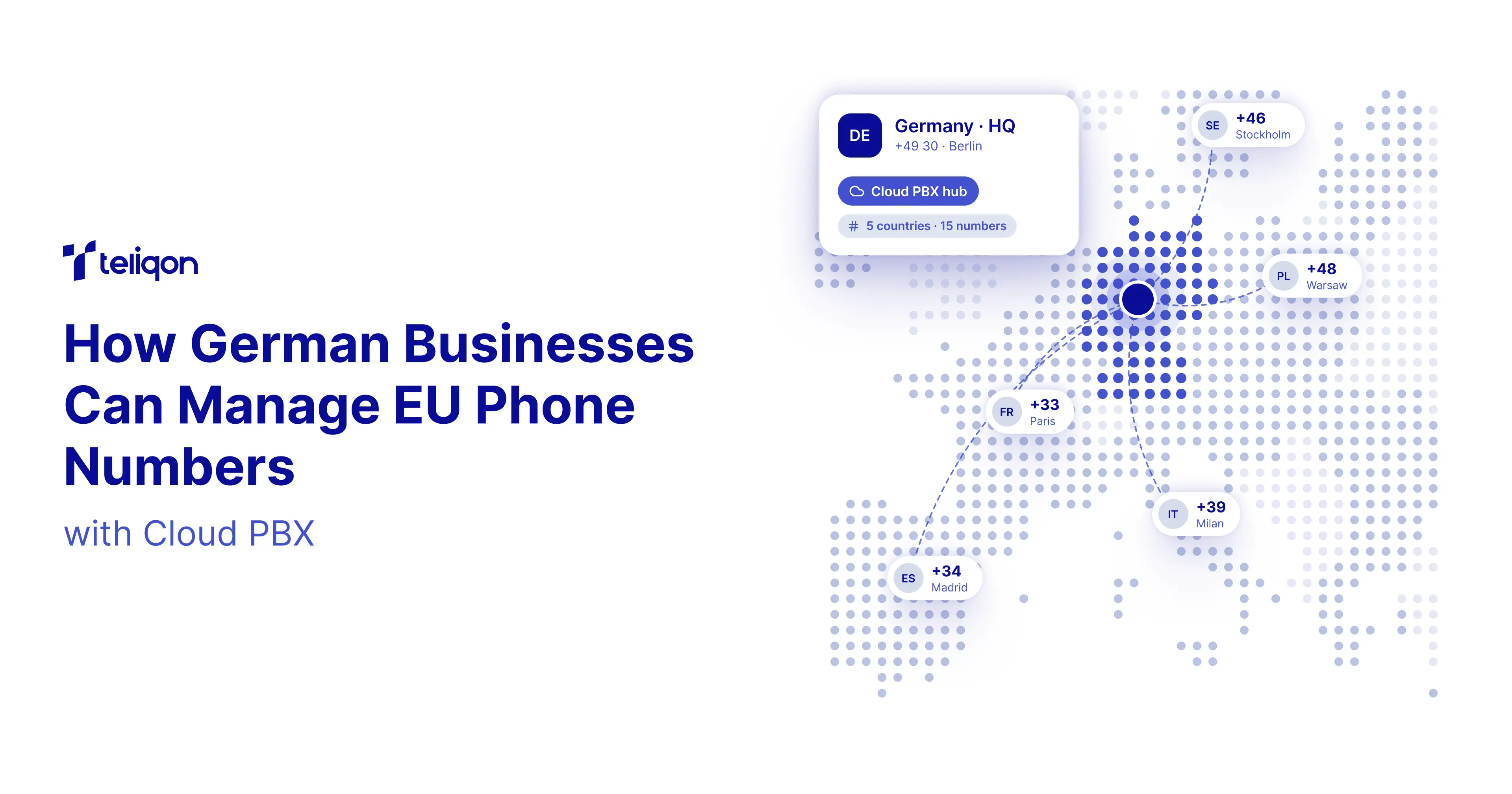
How German Businesses Can Manage EU Phone Numbers with Cloud PBX
A German company expanding into Poland, Czechia, France, or other European markets faces a common communication challenge: customers need an accessible local contact number, but sales and support teams cannot efficiently manage a different phone system in every country.
Traditional expansion often involves separate telecom contracts, disconnected call records, multiple administration interfaces, and inconsistent customer support workflows. These challenges become more significant when employees work remotely or serve customers across different languages and time zones.
International business phone numbers in Germany can be part of a centralized communication strategy. By connecting eligible European phone numbers to a Cloud PBX, businesses can organize international calls, manage distributed teams, and maintain consistent customer service without deploying an independent telephone system for every market.
The key is to combine suitable numbering resources, reliable call routing, and a business communication platform that supports international operations.
Key Takeaways
-
One Cloud PBX can manage calls from multiple European phone numbers, provided the numbers and routing arrangements are supported.
-
Local EU phone numbers are subject to national regulations. Some require business registration, identification documents, or proof of a qualifying local presence.
-
Centralized VoIP simplifies international call management by connecting regional customer numbers with shared teams, queues, and communication workflows.
-
Teliqon combines international virtual numbers with Cloud PBX features, including IVR, call queues, call forwarding, CRM integrations, and analytics.
How Can a German Company Manage Multiple EU Phone Numbers?
A German company can manage multiple EU business phone numbers by connecting eligible local, national, or toll-free numbers to a centralized Cloud PBX. Incoming calls are routed to appropriate teams through extensions, IVR menus, and call queues. This approach allows businesses to coordinate international communication without maintaining a separate telephone system in each country.
For example, a Berlin-based company may use a German number for domestic customers, a Polish number for regional sales, and a Czech number for customer support.
Although customers dial different numbers, calls can reach teams operating through the same communication platform.
The approach is particularly relevant to businesses with international customers, multiple offices, remote employees, or centralized customer service operations.
Understanding EU Business Phone Numbers
European business phone numbers are not interchangeable. Their availability, geographic characteristics, and permitted usage depend on national numbering plans.
Selecting the appropriate number type is therefore an essential step in international expansion.
Local Geographic Phone Numbers
Local phone numbers contain geographic area codes associated with particular cities or regions.
In Germany, the country code is +49, while local codes include 30 for Berlin and 89 for Munich.
A company serving customers in several European markets may benefit from using geographically relevant contact numbers where those numbers are available and the company satisfies local regulations.
For example, a German business entering the Polish market could evaluate whether it qualifies for a Polish geographic number. If the number can be provisioned and routed through its communications provider, Polish customers can contact the business without the company installing a separate PBX in Poland.
The availability of the number and the right to use it must be confirmed independently of the technical routing arrangement.
For domestic numbering options, explore Teliqon Local Phone Numbers in Germany.
Toll-Free Numbers
Toll-free numbers are frequently used for customer support, service inquiries, and inbound sales campaigns.
In Germany, the 0800 range is used for freephone services.
A German toll-free number can provide a convenient customer contact channel for callers within its supported service area.
However, businesses should not assume that a national toll-free number is reachable or free from every other European country.
Before choosing a toll-free number, check mobile network accessibility, international reachability, inbound traffic charges, and any applicable restrictions.
Learn more about Teliqon Toll-Free Numbers in Germany.
Virtual Phone Numbers and DID Technology
A virtual phone number allows incoming calls to be delivered to a configured telephone destination without requiring a separate traditional telephone line at every employee's location.
Many business virtual numbers function as Direct Inward Dialing (DID) numbers.
A DID can be connected to compatible SIP infrastructure or a Cloud PBX, allowing incoming calls to reach extensions, call queues, or other configured destinations.
This makes virtual phone numbers useful for businesses with remote teams, international customer support operations, or offices in multiple countries.
However, voice-enabled virtual numbers do not automatically support SMS, banking authentication, or OTP verification. These capabilities must be checked separately.
Separate National PBX Systems vs. Centralized Cloud PBX
One of the most important decisions for an internationally operating company is whether to maintain independent phone systems across national markets or consolidate supported communication workflows within one platform.
Both approaches are technically possible, but their operational implications differ.
A centralized Cloud PBX does not remove national numbering requirements or guarantee lower costs in every situation.
Its primary value is operational consistency: employees, managers, and IT teams can work within a coordinated communication environment.
For organizations managing several EU markets, this can reduce fragmentation and make communication workflows easier to maintain.
How to Set Up a Multi-Country VoIP Solution
A successful multi-country deployment requires more than obtaining additional telephone numbers.
Companies should establish an operational model covering numbering, call handling, staff responsibilities, integrations, and reporting.
Step 1: Define the Countries and Business Requirements
Start by identifying the markets in which customers need to contact the business.
For each country, document:
-
Required local, national, or toll-free numbers.
-
Expected inbound and outbound calling volumes.
-
Languages supported by sales and customer service.
-
Business hours and time zone requirements.
-
Customer service departments and escalation processes.
-
CRM and reporting requirements.
-
Numbering regulations and registration conditions.
This assessment helps prevent unnecessary purchases and ensures that the proposed architecture meets real operational needs.
Step 2: Verify Phone Number Availability and Eligibility
European telephone numbering is regulated nationally, even though countries operate within a common EU telecommunications framework.
Some geographic numbers may require evidence of a qualifying local presence or connection to a particular numbering area.
Other number categories may have different requirements.
Before ordering international numbers, confirm the documentation required for each destination and the conditions under which numbers may be used.
For Teliqon, the official Virtual Numbers documentation states that numbers are assigned to customer projects by the support team following mandatory identity verification.
Businesses should account for this process during implementation planning.
Step 3: Connect Numbers to a Cloud PBX
Once the required numbers are approved and assigned, they can be connected through the supported communication architecture.
A Cloud PBX enables businesses to organize calling operations using virtual extensions, routing rules, queues, and other call management features.
Depending on the configuration, a company may route calls arriving through several country-specific numbers to the appropriate agents or departments.
The result is a shared communication workflow rather than a collection of disconnected national telephone systems.
Step 4: Configure International Call Routing
Call routing determines where an incoming call should go and how it should be handled.
For example:
-
Calls to the German customer service number reach a German-speaking queue.
-
Calls to an eligible Polish number reach the regional sales team.
-
Calls arriving outside business hours are redirected according to the configured schedule.
-
Customers can select departments using an IVR menu.
-
Agents can transfer calls to the appropriate available colleagues.
Automatic Call Distribution (ACD) helps organize incoming calls across available agents, while IVR provides structured navigation for callers.
Teliqon includes these technologies in its Cloud PBX offering.
Step 5: Integrate Communication with CRM
For companies operating internationally, customer context matters.
An agent receiving a call should ideally have access to relevant information about the customer, previous communication, and ongoing business activities.
Supported CRM integrations can help connect calling workflows with customer records and sales or service processes.
Teliqon provides integrations with business applications and CRM platforms. The exact integration capabilities and supported data fields depend on the selected system and configuration.
For teams managing customers across different countries, this connectivity can support more consistent communication.
Step 6: Monitor International Communication Performance
After deployment, companies should monitor call activity to understand how their communication system performs.
Useful indicators include:
-
Incoming call volume by destination number.
-
Answered and missed calls.
-
Call queue waiting times.
-
Agent activity.
-
Call handling duration.
-
Department-level call distribution.
These metrics can help managers identify operational bottlenecks, adjust staffing schedules, and review call-routing performance.
The goal is not merely to manage more telephone numbers, but to provide a reliable communication experience across markets.
How Teliqon Helps German Businesses Manage EU Communications
Teliqon is a global cloud communications platform providing business telephony services, virtual phone numbers, and cloud-based call management tools.
For German companies serving customers internationally, Teliqon combines several relevant capabilities.
International Virtual Phone Numbers
Teliqon offers virtual phone numbers for business communication across international markets.
The platform advertises numbering coverage in more than 170 countries, although the actual availability of local, mobile, national, or toll-free numbers depends on the destination and applicable requirements.
Businesses can evaluate appropriate numbering options for their operating markets rather than assuming every country requires a completely separate communication provider.
Explore Teliqon Virtual Phone Numbers.
Cloud PBX for Centralized Call Handling
Teliqon Cloud PBX Germany supports business calling workflows through features such as:
-
Virtual extensions and call forwarding.
-
Interactive Voice Response.
-
Automatic Call Distribution.
-
Call queues.
-
Call recording.
-
Call analytics and reporting.
-
Supported CRM integrations.
These capabilities help companies organize inbound and outbound business communication within a consistent operating environment.
For international teams, the practical advantage is the ability to coordinate call handling without requiring employees to work from the same physical location.
DID Administration Through the Teliqon Portal
The Teliqon Portal provides access to information about virtual phone numbers assigned to a customer project.
According to the official documentation, users can search for assigned DIDs, filter records by country code, review number-related billing information, and export number lists in CSV format.
This functionality supports number inventory management and gives administrators visibility into assigned resources.
It is important to distinguish number inventory administration from call-routing configuration, which depends on the connected telephony services.
CRM Integration and Customer Communication
Teliqon also supports integration with CRM systems and business applications.
This can help companies coordinate calling activity with existing customer service and sales processes.
For organizations operating across different European markets, combining Cloud PBX and supported CRM integration can create a more consistent way of managing customer conversations.
A Practical Deployment Approach
A German business planning to operate in several countries can discuss the complete communication requirements with Teliqon rather than evaluating each number in isolation.
That assessment may include:
-
Which country-specific numbers are available.
-
What registration documents are needed.
-
How calls should be routed between international teams.
-
Which departments need independent queues.
-
What CRM integration is required.
-
How traffic and subscription costs should be structured.
The resulting configuration should reflect actual business requirements, supported platform capabilities, and national numbering conditions.
Example: A German Logistics Company Serving Multiple EU Markets
Consider a hypothetical logistics company headquartered in Hamburg.
The company coordinates freight operations across Germany, Poland, and Czechia, serving customers who need reliable access to dispatch and support teams.
As the business expands, it faces several communication challenges.
German customers call the headquarters. Polish clients need regional assistance. Czech customers require a convenient contact channel. Meanwhile, employees work in different locations, and management needs visibility into communication performance.
Maintaining three independent telephone systems could create unnecessary administrative complexity.
A centralized Cloud PBX offers an alternative.
Example Communication Architecture
All supported numbers can feed into the configured communication architecture.
When a customer calls, the system applies the appropriate routing rules.
A Polish-language inquiry, for example, may reach a regional support queue, while a dispatch issue can be transferred to the relevant operational team.
Managers can monitor supported call activity and adjust workflows as demand changes.
The business value is a coordinated communication process across several countries, rather than simply having more phone numbers.
This example illustrates a possible technical deployment. The availability of particular Polish and Czech number types and their eligibility requirements must be confirmed before implementation.
Managing Business Calls Across Multiple EU Countries?
Teliqon helps international businesses connect eligible virtual phone numbers with centralized Cloud PBX functionality, call routing, and supported CRM integrations.
Explore how your organization could structure communication across Germany and other European markets.
European Numbering Regulations: What German Companies Should Know
European telecommunications markets operate within a common regulatory framework, but national authorities retain responsibility for important aspects of telephone numbering.
The European Electronic Communications Code establishes the overarching framework for electronic communications in the EU.
In Germany, Bundesnetzagentur regulates national numbering resources and publishes relevant allocation information.
Companies planning international numbering deployments should verify three key issues.
Number eligibility. Geographic numbers may require qualifying local connections or documentation. A virtual phone system does not automatically eliminate these requirements.
Number portability. Retaining existing phone numbers when changing providers may be possible, but depends on the national rules, the number type, and the providers involved.
Messaging functionality. A voice-enabled number does not necessarily support SMS or third-party verification services.
Confirming these conditions before implementation helps avoid delays and unexpected operational constraints.
GDPR and International Call Recording
International business telephony may involve the processing of personal information, including caller numbers, call records, recordings, and CRM-linked contact details.
Organizations must comply with applicable data protection requirements, including the General Data Protection Regulation.
Relevant obligations may include establishing a legal basis for processing, providing appropriate privacy notices, controlling access to information, and defining retention procedures.
Call recording requires particular care.
The European Data Protection Board provides guidance on data protection obligations, while Section 201 of the German Criminal Code addresses unauthorized recording of non-publicly spoken words.
A Cloud PBX recording feature is a technical capability, not an automatic guarantee of legal compliance.
Before enabling recording, businesses should evaluate applicable legal requirements and configure appropriate operational safeguards.
Common Mistakes in Multi-Country Business Telephony
Choosing Numbers Without Checking Eligibility
International number availability should be confirmed for the exact destination and number category.
A provider's overall coverage does not guarantee access to every geographic number.
Assuming Toll-Free Numbers Work Internationally
National toll-free services are not necessarily reachable free of charge from other countries.
Businesses should verify the expected customer calling experience before choosing a number.
Ignoring Outbound Caller ID Requirements
A number suitable for receiving calls may not automatically be approved for every outbound calling scenario.
Caller identification and outbound presentation rules should be checked with the provider.
Comparing Only Monthly Subscription Prices
The full cost of a multi-country phone system may include number rental, setup charges, inbound and outbound traffic, users, and optional features.
An accurate comparison should reflect expected call volumes and country-specific usage.
Overlooking Support and Integration Requirements
A technically compatible phone system may still require configuration, CRM mapping, user training, and documented escalation procedures.
These operational details should be included in the deployment plan.
How to Choose an International VoIP Provider for a German Business
When evaluating a multi-country VoIP solution, companies should look beyond basic calling features.
A suitable provider should be assessed across several dimensions.
The best VoIP provider for a German business with international customers is not necessarily the one advertising the most telephone numbers.
It is the provider whose numbering availability, call management capabilities, commercial terms, and support model align with the organization's operating requirements.
Teliqon is one option to evaluate when a business needs international virtual phone numbers alongside Cloud PBX functionality and supported CRM integrations.
Build a Connected Business Phone System Across Europe
For German businesses expanding into new European markets, the objective should be more than obtaining additional phone numbers.
A sustainable communication strategy connects appropriate local customer contact channels with efficient internal workflows, consistent service operations, and clear administrative control.
Using international business phone numbers with a centralized Cloud PBX can help organizations manage calls across different markets without deploying an independent telephone system in every country.
Teliqon brings together international virtual numbering, Cloud PBX functionality, call routing, analytics, and supported business integrations in one communications offering.
Whether your company is expanding into Poland, Czechia, or other European markets, the first step is identifying the appropriate numbering resources and designing a communication architecture that matches your business requirements.
Ready to centralize your European business communications?
Explore Teliqon Virtual Phone Numbers and Cloud PBX Germany, or contact Teliqon to discuss international numbering, call routing, and integration requirements.
Sources and Further Reading
Arthur Kyselevskyi

Follow Us in social networks


The latest from Teliqon
Stay ahead with insights from the leader in trusted communications. Subscribe for the latest blogs, updates, and exclusive content.