



Oleh Romaniuk
November 23, 2026
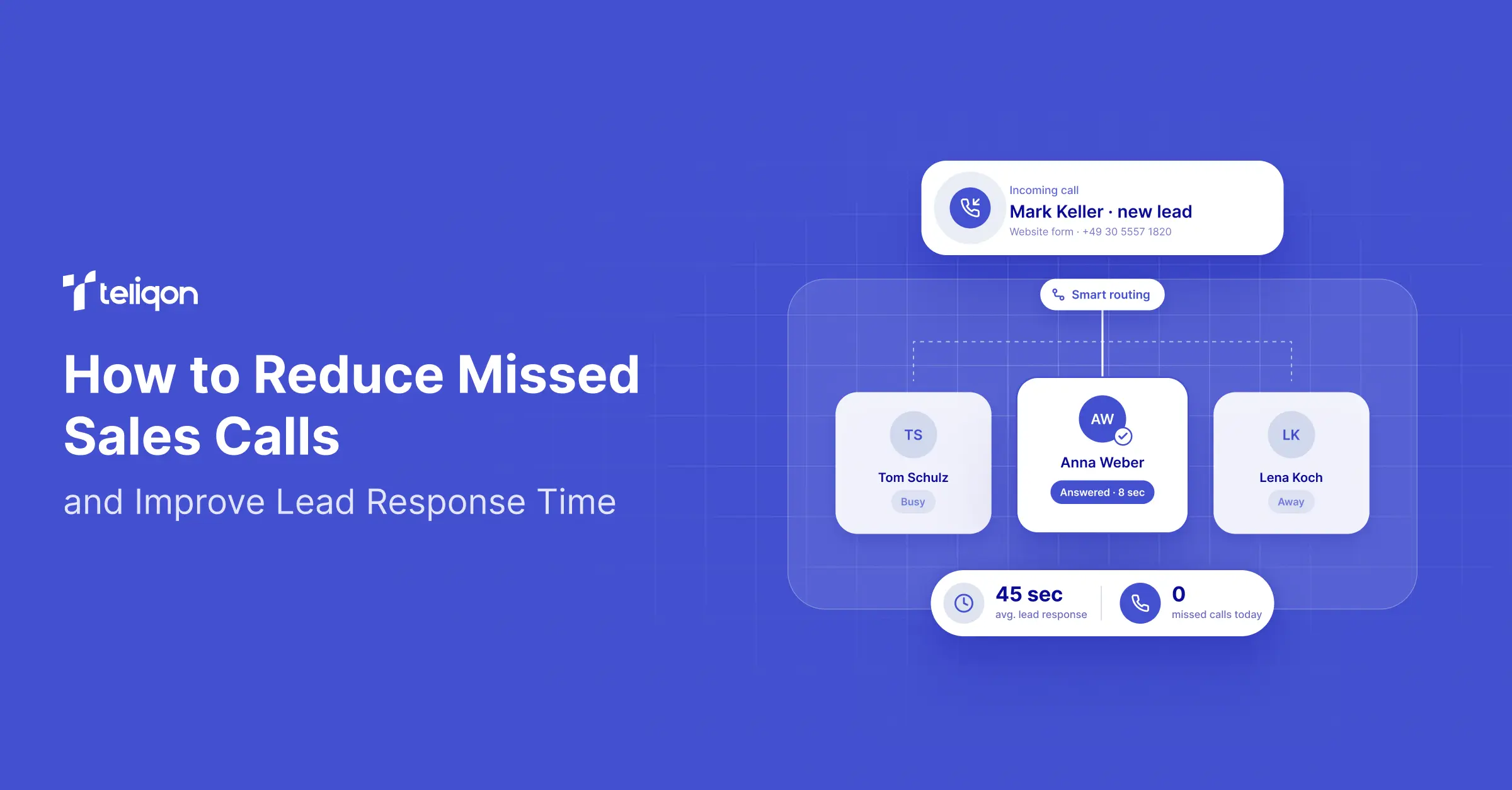
How to Reduce Missed Sales Calls and Improve Lead Response Time
A potential customer calls your business to discuss a service, request pricing, or schedule a demonstration. Nobody answers.
The caller tries again, waits in a queue, or leaves a message. Meanwhile, your sales representatives are handling other conversations, and nobody is clearly responsible for returning the missed call.
Another prospect submits a demo request through your website. An automated email confirms the submission immediately, but the first meaningful conversation with a sales representative happens the following day.
Both situations reveal the same operational problem: customer demand has reached the business, but the response process has failed to connect it with the right person at the right time.
For B2B organizations, reducing missed sales calls requires more than a telephone system. It requires appropriate call routing, agent availability, callback management, CRM follow-up, clear ownership, and measurable response targets.
Cloud telephony can support this process through IVR, Automatic Call Distribution, call queues, forwarding, callback services, and communication reporting.
This guide explains seven ways to reduce missed sales calls, improve lead response time, recover unanswered inquiries, and measure the commercial value of a more reliable inbound response process.
Key Takeaways
-
A missed call is not necessarily a lost lead. The final outcome depends on whether the customer eventually reaches the company and receives appropriate follow-up.
-
Speed-to-lead research primarily examines web inquiries. Its findings should not be treated as direct proof of the effectiveness of missed-call recovery software.
-
Call routing and queues help prevent missed calls. They distribute inbound inquiries according to configured rules and agent availability.
-
Callbacks provide an alternative when immediate contact is unavailable. The process still requires ownership, adequate staffing, and follow-through.
-
CRM integration supports communication history. Automatic technical call logging does not necessarily create follow-up tasks or qualify opportunities.
-
Reporting definitions matter. An unanswered extension is not always an unanswered call at the company level.
-
Recovery performance should be measured through outcomes. First human response, callback completion, unreached leads, and qualified opportunities provide different perspectives.
What Are Missed Sales Calls and Lead Response Time?
Before improving inbound sales performance, organizations need consistent definitions.
What Is a Missed Sales Call?
A missed sales call is an inbound telephone attempt from a potential or existing customer that does not reach an appropriate representative during that interaction.
However, not every unanswered extension represents a missed call for the entire business.
For example, one incoming call may ring five representatives. Four do not answer, but the fifth accepts the call.
From the customer's perspective, the business answered successfully.
From a technical perspective, several individual extensions may have unanswered ringing events.
Confusing these events can make a company's missed-call statistics misleading.
What Is Lead Response Time?
Lead response time measures the interval between receiving a sales inquiry and a defined response event.
Different events measure different things.
These measurements should remain separate.
An automated email sent within seconds may confirm that a request was received, but it does not establish that the customer has spoken to a sales representative.
The objective is not merely to acknowledge inquiries quickly. It is to connect qualified demand with an appropriate employee and a clearly managed next step.
Why Lead Response Speed Matters: Evidence from Web Inquiries
Research into online sales inquiries consistently identifies response time as an important operational consideration.
However, these studies primarily examine web-generated leads, not the final outcomes of inbound telephone calls.
That distinction is essential.
Harvard Business Review: Early Contact and Lead Qualification
In The Short Life of Online Sales Leads, published in 2011, Harvard Business Review discussed research involving approximately 1.25 million sales leads from 42 US companies.
The researchers reported that organizations attempting contact within one hour were nearly seven times as likely to qualify a lead as companies waiting at least another hour.
The difference was even greater compared with companies waiting 24 hours or longer.
Source: Harvard Business Review — The Short Life of Online Sales Leads.
This historical research demonstrates an association between earlier attempts and qualification outcomes in the studied web-lead population.
It does not prove that answering every missed call within one hour produces seven times more customers or revenue.
The Five-Minute Lead Response Rule
Earlier InsideSales.com lead response research also found substantial differences in contact and qualification outcomes between very fast responses and longer delays.
This work helped popularize the five-minute lead response benchmark.
However, the findings should not be translated into claims such as "calling within five minutes increases sales by 21 times."
The underlying studies measured specific contact and qualification outcomes in historical datasets.
For modern B2B organizations, the better application is to establish realistic response targets for high-intent inquiries and measure performance against them.
Chili Piper: Slow Responses to Demo Requests
Chili Piper's 2022 study examined how B2B software companies responded to website demo requests.
More than 80% of the companies studied responded later than five minutes or did not respond within the study's observation period.
Approximately 30% provided no response during that period.
Only around 7% responded in less than 60 seconds.
Source: Chili Piper — Average B2B Vendor Response Times.
These results describe a specific vendor-conducted audit of web inquiries.
They are not statistics about unanswered business phone calls or the performance of callback systems.
Clay: A 2026 Experiment Involving 6,346 B2B Inquiries
On September 22, 2026, Clay published an experiment involving 6,346 demo and contact requests to companies across 100 countries.
The researchers used automated agents and a consistent test identity to submit the inquiries.
The reported results included:
Source: Clay — Speed-to-Lead Experiment.
The 96% figure describes organizations that did not call the supplied test number under the experiment's conditions. It does not mean that 96% of B2B companies never call genuine leads.
Clay also acknowledged methodological limitations, including the possibility that companies filtered the submissions as spam or judged them irrelevant.
What Sales Leaders Should Learn from These Studies
The research supports three practical conclusions.
First, response delays should be measured and managed.
Second, automated acknowledgments should not be confused with meaningful sales conversations.
Third, an effective response process must connect the inquiry to an appropriate employee.
These findings support better lead response management. They do not independently establish the conversion uplift of any particular Cloud PBX, call queue, or callback product.
Why Missed Phone Calls Require a Different Recovery Process
Unlike a website form, an incoming phone call is a real-time attempt to communicate.
The caller may expect an immediate conversation.
If that conversation does not occur, the business must determine what happened and whether another action is required.
That makes missed-call recovery a distinct operational process.
The Three Stages of Inbound Call Management
Prevention
Use routing, appropriate agent coverage, call queues, and alternative destinations to help customers reach the business.
Recovery
When immediate contact is unavailable, provide a suitable callback, voicemail, or follow-up process.
Accountability
Ensure that relevant unresolved inquiries have a responsible employee, response target, and recorded outcome.
A company can have excellent call routing and still lose opportunities if nobody follows up on missed inquiries.
Conversely, it can operate an efficient callback process while creating unnecessary workload through poor initial routing.
The greatest benefit comes from coordinating all three stages.
Why Sales Teams Miss Calls or Respond Too Slowly
Calls Depend on One Representative
A business number may route to a single employee, even though several people could handle the inquiry.
If that person is occupied, the call may go unanswered.
Incoming Demand Exceeds Agent Availability
Busy periods can create longer queues or more unanswered calls.
Without suitable overflow and fallback rules, customers may disconnect before reaching a representative.
After-Hours Coverage Is Undefined
Prospects in different time zones may contact the business outside the main team's working hours.
Without clear handling rules, their inquiries can remain unresolved.
Missed Calls Have No Owner
A missed-call notification may appear in a dashboard without any employee being responsible for resolving it.
CRM Information Is Fragmented
Representatives may not know whether another employee has already contacted the caller.
This can create repeated questions or duplicated callbacks.
Automated Confirmations Are Mistaken for Human Responses
An immediate email can create the impression of a fast response even when the customer has not received meaningful assistance.
Reporting Counts Technical Events Rather Than Customer Outcomes
Multiple unanswered extension events may be counted as multiple lost leads, although they originated from a single call.
Each problem requires a different response.
7 Ways to Reduce Missed Sales Calls and Improve Lead Response Time
1. Route Inbound Calls to the Right Team
Problem: Customers are transferred between employees or routed to unsuitable destinations.
Interactive Voice Response (IVR) allows a business to organize incoming calls around predefined options and routing rules.
For example, a B2B company may create separate paths for:
-
New sales inquiries.
-
Existing customer questions.
-
Technical support.
-
Billing.
Teliqon Cloud PBX supports IVR and configurable call routing.
An appropriate routing structure can help callers reach a relevant team with fewer manual transfers.
Recommended KPI: Time to human answer and unnecessary transfer rate.
Practical recommendation: Keep menus short and review whether customers can easily identify the correct option.
2. Use Call Queues and Overflow Rules
Problem: All relevant representatives are temporarily occupied.
Call queues organize incoming calls while the team handles existing conversations.
Teliqon Call Queue supports configurable routing, queue priorities, overflow rules, and relevant caller announcements.
When suitable, a company can configure an alternative route when the primary team cannot accept a call.
Example:
-
A prospect calls the sales department.
-
IVR selects the appropriate queue.
-
Automatic Call Distribution routes the call according to configured rules.
-
If an agent is unavailable, the call follows queue or overflow handling.
-
The call reaches a representative or proceeds to an alternative configured destination.
Recommended KPIs: Answer rate, queue waiting time, queue abandonment, and overflow outcomes.
3. Offer Callbacks When Customers Cannot Reach an Agent
Problem: A prospect does not want to wait or calls when no representative is available.
A callback service offers an alternative to holding or repeatedly dialing the company's number.
Teliqon Call Back documents callback requests, scheduling, and configurable callback handling for supported scenarios.
The practical objective is to organize a subsequent contact attempt rather than leave the caller without a defined recovery path.
When Should Businesses Use Call Back?
A callback service is not identical to voicemail.
Voicemail allows the customer to leave information. A callback workflow organizes a subsequent attempt to reach the customer.
Both can be useful, depending on the situation.
Why Callback Management Matters
A callback should have:
-
A clear trigger or customer request.
-
An appropriate scheduled time.
-
A responsible team or employee.
-
A documented outcome.
-
A procedure for unsuccessful return attempts.
Not every requested callback will result in a successful conversation.
Customer availability, staffing, permissions, and response timing still matter.
Recommended KPIs: Callback completion, successful callback conversations, and average callback delay.
4. Give Every Unresolved Inquiry a Responsible Owner
Problem: Missed calls are visible, but nobody is accountable for follow-up.
A reliable recovery process should identify who is responsible for each relevant unresolved inquiry.
Recommended information includes:
-
Customer or caller identification.
-
Responsible employee or team.
-
Current inquiry status.
-
Follow-up priority.
-
Response target.
-
Last contact attempt.
-
Next action.
Some of these fields and processes may require CRM configuration.
A Cloud PBX call record does not automatically provide a complete task-management process.
Recommended KPI: Percentage of relevant unresolved inquiries with an assigned owner.
5. Connect Calling with CRM Follow-Up
Problem: Calling information is separated from customer records.
Teliqon Cloud PBX documents integrations with Salesforce, HubSpot, Zoho CRM, Microsoft Dynamics 365, Pipedrive, Odoo, and SugarCRM.
Depending on the CRM and integration settings, relevant capabilities include contact lookup, caller identification, call journals, click-to-call, and recording access.
These functions can help employees identify callers and maintain communication history.
However, automatic call logging is different from CRM business automation.
A separate CRM workflow may be required to create a follow-up task, assign responsibility, or update an opportunity.
Recommended KPI: Eligible calls associated with the correct CRM records and completed follow-up tasks.
Review Teliqon CRM Integrations
6. Establish Realistic Response SLAs
Problem: Sales employees have no consistent expectation for responding to inbound inquiries.
A response SLA defines the timing and responsibilities for particular types of requests.
For example:
These values are examples of internal management targets, not legal standards or guaranteed Teliqon performance commitments.
Companies should establish targets based on their sales process, staffing, geographic coverage, and customer expectations.
Recommended KPI: Percentage of eligible inquiries meeting the defined response target.
7. Measure the Final Outcome, Not Just Missed Events
Problem: Managers see telephone activity but cannot determine how many unique customer inquiries remain unresolved.
Teliqon provides call records and reporting capabilities that can support operational monitoring.
CRM information can add ownership and commercial outcomes.
A useful report should separate:
-
Inbound call attempts.
-
Unanswered business-level attempts.
-
Individual extension ringing events.
-
Unique callers.
-
Callback obligations.
-
Successful conversations.
-
Qualified sales opportunities.
Recommended KPIs: Company-level missed-call rate, callback completion rate, and unreached unique leads.
Teliqon Call Queue vs Call Back vs Call Forwarding
These tools serve different purposes.
A company may combine several mechanisms within one inbound process.
For example, IVR can route the call to a sales queue. When representatives are unavailable, the configured workflow may offer a callback.
CRM processes can then help track ownership and the outcome.
These are complementary mechanisms, not interchangeable features.
Inbound Lead Recovery Workflow: From Missed Call to Qualified Opportunity
A structured recovery process should make every relevant inquiry traceable.
Capture → Identify → Route → Recover → Assign → Respond → Verify
Capture
Receive the inbound telephone call or website inquiry through the approved business channel.
Identify
Recognize the caller and locate an existing CRM contact where supported and permitted.
Route
Send the inquiry to the appropriate representative or team through the configured call flow.
Recover
When immediate contact is unsuccessful, use callback, voicemail, or another suitable follow-up mechanism.
Assign
Give an employee or team ownership of the unresolved inquiry.
Respond
Complete the relevant contact attempt or agreed customer interaction.
Verify
Record the result: reached, rescheduled, qualified, unqualified, opted out, or another appropriate status.
This is a conceptual business workflow.
Not every step is automatically performed by Cloud PBX. CRM task creation, qualification, and opportunity management may require separate systems and configuration.
Why Verification Is Essential
A callback marked as attempted does not necessarily mean the customer answered.
A customer who answers is not necessarily qualified.
And a qualified prospect is not automatically a new customer.
Each event should be recorded and evaluated according to its actual business meaning.
A Critical Reporting Detail: Missed Extension vs Missed Company Call
Imagine a sales queue with five representatives.
An inbound call rings several extensions.
Four employees do not answer, but the fifth accepts the call.
The customer reached the company successfully.
Yet individual extension records may indicate several unanswered ringing events.
If these are counted as lost sales opportunities, management receives distorted information.
Teliqon CRM Logging Configuration
Teliqon CRM documentation includes the setting:
Disable Display Missed Call Records in Unanswered Agents
In supported queue and ring-group configurations, this setting helps prevent redundant missed-call entries from appearing in the CRM for agents who did not answer when another agent handled the call.
This can make CRM communication history more meaningful.
It should not be interpreted as changing all underlying PBX records or automatically calculating unique lost leads.
Two Separate Reporting Measures
Company-Level Missed-Call Rate
Unanswered eligible inbound call attempts divided by total eligible inbound attempts.
Unreached Unique Leads
The number of distinct relevant prospects who have not received a successful response within the defined reporting period.
A caller who dials three times, receives no answer twice, and is connected on the third attempt generates:
-
Three inbound attempts.
-
Two unanswered attempts.
-
One answered attempt.
-
One unique caller.
-
One ultimately reached customer.
These measurements describe different aspects of the same customer journey.
How to Measure Inbound Sales Response Performance
A useful inbound response scorecard should combine operational and commercial indicators.
Reporting definitions should account for repeated calls, spam, business hours, unique contacts, and customer-requested callbacks.
Some indicators can be supported by telephony reporting. Others require CRM data or additional measurement processes.
Business Example: Reducing Missed Calls and Improving Lead Recovery
Consider a hypothetical B2B company receiving 1,000 eligible inbound call attempts per month.
After reviewing routing, queue coverage, callback handling, and CRM ownership, the company compares two operating periods.
All figures are illustrative assumptions, not actual Teliqon customer results.
What Changed?
The missed-call rate decreased from 18% to 10%.
Callback completion increased from 60% to 90%.
The absolute number of completed callbacks decreased, but that is not necessarily negative because fewer calls required recovery.
The example also assumes that qualified opportunities increase from 100 to 115.
That increase is not a mathematically guaranteed consequence of improved call routing or callback management.
A real business would need to verify opportunity attribution and consider changes in customer demand, lead quality, staffing, and sales performance.
Extending the Model to Potential Commercial Value
Suppose the company maintains an illustrative 20% qualified-opportunity-to-customer conversion rate.
Assume each new customer produces an average contribution margin of $1,000 over the defined measurement period.
Under these assumptions, the potential contribution-margin difference is $3,000.
This is an illustrative economic scenario, not a documented revenue increase or proof of causation.
The difference cannot automatically be attributed to the Cloud PBX or callback improvements.
Calculating Actual ROI
To estimate ROI, the business should establish which additional opportunities and customers are reasonably attributable to the changes.
It must also account for:
-
Additional software subscriptions.
-
Telephone traffic and numbers.
-
Configuration and integration work.
-
Employee time.
-
Training.
-
Ongoing administration.
-
Any additional operational costs.
A simple formula is:
ROI = (Verified Incremental Financial Benefit − Total Incremental Costs) / Total Incremental Costs × 100%.
Without evidence connecting the process changes to actual financial benefits, the company should report operational improvements rather than claim a confirmed ROI.
A 30-Day Plan to Improve Missed-Call Recovery
Week 1: Audit Inbound Demand
Review missed calls, unique callers, queues, business hours, CRM records, and callback completion.
Clarify whether the current reporting counts company-level outcomes or individual extension events.
Deliverable: Baseline inbound response dashboard.
Week 2: Improve Routing and Recovery
Review IVR, ACD, call queues, overflow handling, forwarding, and callback configuration.
Establish responsible teams and CRM follow-up procedures.
Test busy periods, after-hours calls, and repeated inquiries.
Deliverable: Documented and tested inbound response workflow.
Week 3: Pilot the New Process
Monitor real customer interactions.
Evaluate call accessibility, waiting time, callback completion, CRM logging accuracy, and employee feedback.
Investigate unresolved inquiries.
Deliverable: Pilot report and targeted improvements.
Week 4: Evaluate and Standardize
Compare results with the baseline, accounting for staffing, demand, and business hours.
Review both operational indicators and commercial outcomes.
Establish ongoing ownership and reporting responsibilities.
Deliverable: Approved response process and regular performance review.
Common Mistakes That Cause Companies to Lose Inbound Leads
Counting Every Missed Extension as a Lost Lead
Technical ringing events do not necessarily represent different missed customers.
Measure final call outcomes and unique unresolved inquiries.
Assuming Voicemail Guarantees Follow-Up
A recorded message still requires review, assignment, and response.
Creating Callback Requests Without Capacity
A callback system can accumulate overdue obligations if staffing is insufficient.
Reserve capacity for agreed follow-ups.
Measuring Automated Emails as Successful Responses
A confirmation is not the same as a meaningful conversation.
Track the two events independently.
Using One SLA for Every Inquiry
Different requests have different urgency and handling needs.
Set appropriate response targets according to priority, staffing, and customer expectations.
Assuming CRM Call Logging Automates Sales Tasks
Call journals and opportunity workflows are different functions.
Configure CRM responsibilities and automation separately.
Reporting More Qualified Opportunities as Guaranteed Revenue
Opportunity growth is not the same as realized revenue or profit.
Measure conversion and financial outcomes using actual data.
Final Recommendations: Make Every Inbound Inquiry Accountable
A missed call is not automatically a lost customer.
But an unresolved inquiry without a clear owner, response target, and documented outcome creates avoidable operational risk.
For CEOs and CSOs, the priority should be building a reliable process that connects incoming customer demand with qualified sales conversations.
For inbound sales managers, that means preventing avoidable missed calls, recovering unanswered inquiries, and ensuring that follow-up commitments are completed.
For Sales Operations teams, the challenge is maintaining accurate reporting that distinguishes technical call events from actual customer outcomes.
Teliqon Cloud PBX, Call Queue, and Call Back provide communication capabilities that can support these objectives.
Together with appropriately configured CRM workflows and operational responsibilities, they can form part of a more consistent inbound sales response process.
Request an Inbound Call Flow Demo
Want to improve how your business handles incoming sales calls?
Share your current call volumes, missed-call challenges, team availability, CRM, and callback requirements.
Explore how Teliqon Cloud PBX, Call Queue, and Call Back can support a suitable inbound response configuration.
Sources and Further Reading
Oleh Romaniuk

Follow Us in social networks


The latest from Teliqon
Stay ahead with insights from the leader in trusted communications. Subscribe for the latest blogs, updates, and exclusive content.