



Arthur Kyselevskyi
November 9, 2026
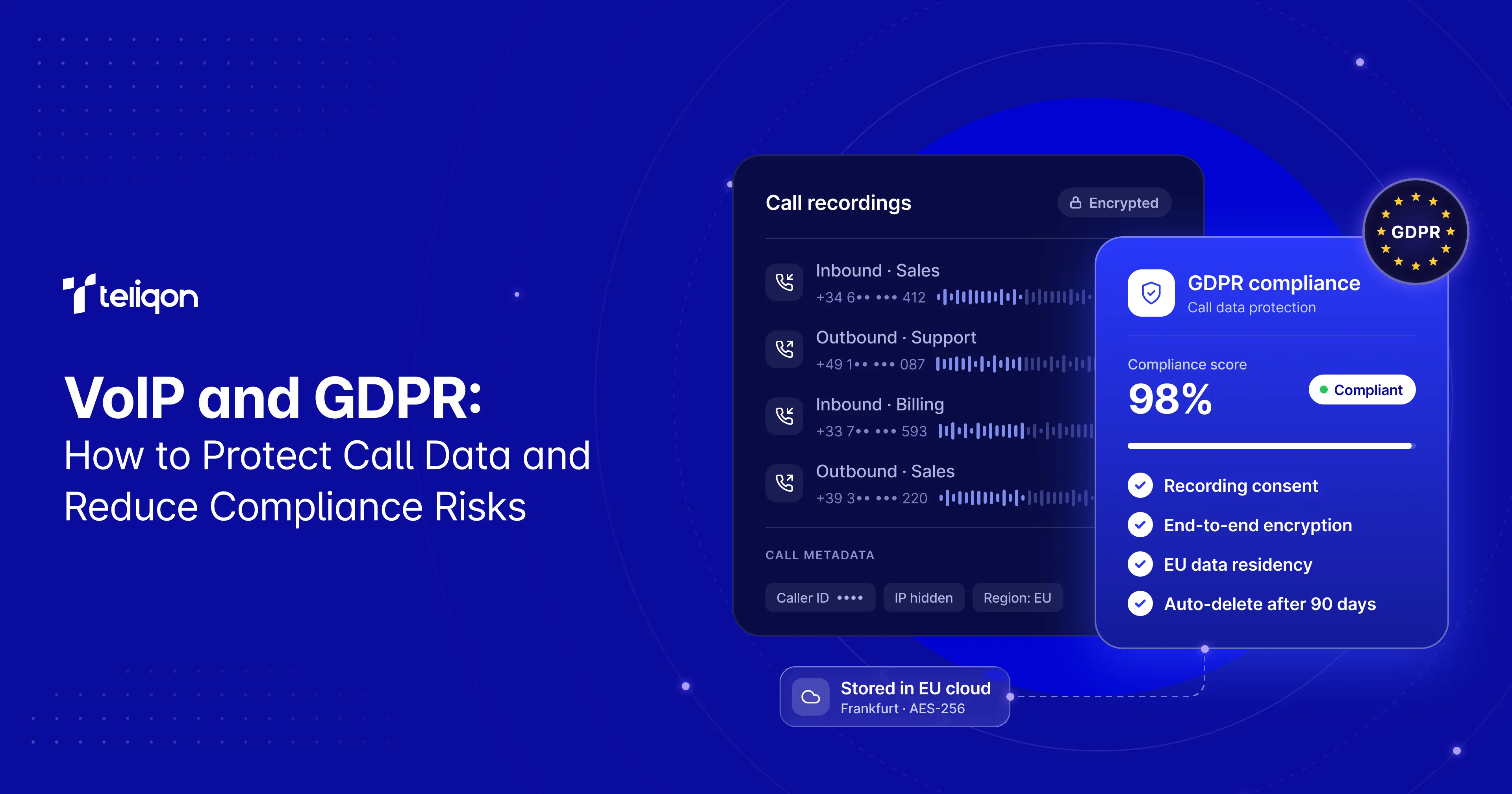
VoIP and GDPR: How to Protect Call Data and Reduce Compliance Risks
A business phone call may seem simple: a customer calls, an employee answers, and the conversation ends.
However, your phone system may also process phone numbers, customer names, call history, recordings, voicemails, CRM details, and employee information.
This is where GDPR becomes important for business telephony.
The problem is that most companies concentrate on securing their CRM databases and customer accounts while failing to address the personal data that passes through their phone system. Since modern VoIP is part of the IT environment, the data it processes deserves the same protection as information stored in other business systems.
Then what are the main risks in business telephony and in what way can an appropriate VoIP system help to reduce them?
What Personal Data Does a VoIP System Process?
A common misconception is that GDPR only applies to business phone systems when call recording is enabled. In reality, VoIP platforms process personal data during everyday communication, even when conversations are not recorded.
Depending on the system configuration, this may include:
-
Personal identifiers: Names, phone numbers, email addresses, and customer contact details.
-
Call metadata: Caller and recipient numbers, call timestamps, duration, missed calls, and communication history.
-
Voice data: Call recordings, voicemail messages, and AI-generated transcripts.
-
Employee information: Agent identities, extensions, call activity, and performance statistics.
-
CRM data: Customer profiles, contact records, interaction history, and information synchronized between integrated systems.
-
Technical data: IP addresses, device identifiers, call routing information, and system access logs.
Call recordings and transcripts may contain additional personal information, including financial details, health information, or other sensitive data shared during conversations.
Under GDPR, businesses must understand not only what personal data their VoIP system processes, but also why it is collected, where it is stored, who can access it, and how long it is retained.
Does GDPR Apply to VoIP and Call Recording?
Yes. GDPR applies when businesses process personal data through VoIP systems within the regulation's territorial scope. This includes call metadata, customer records, voicemail, recordings, and other information that can identify an individual.
GDPR Article 5 establishes core data protection principles, including purpose limitation, data minimization, storage limitation, and confidentiality. Under Article 6, organizations must identify an appropriate lawful basis for processing personal data. Articles 13 and 14 also establish requirements for informing individuals about how their information is processed.
Call recording introduces additional legal considerations. Businesses must determine why conversations need to be recorded, establish an appropriate lawful basis, and provide relevant privacy information. Depending on the country, national call recording laws and electronic communications confidentiality rules may impose additional requirements, including consent.
Importantly, having a lawful basis under GDPR does not automatically authorize recording a telephone conversation. Businesses operating across multiple EU countries should assess the applicable national requirements before enabling recording features.
Beyond call recording, GDPR obligations also extend to data retention, employee access permissions, CRM integrations, AI transcription, and the involvement of third-party VoIP providers.
The following sections explore the most common GDPR risks in business telephony and how appropriate VoIP functionality can help organizations manage them.
Pain point 1: Calls are recorded without a clear purpose
Modern Cloud PBX systems make it easy to record conversations. The risk appears when recording is enabled across departments or teams without first defining why those calls need to be stored.
Under GDPR Articles 5 and 6, businesses must establish a specific processing purpose and an appropriate lawful basis for recording calls. Article 13 also requires businesses to provide relevant privacy information to callers. However, national call recording laws and electronic communications confidentiality rules may impose additional requirements.
Teliqon's Call Recording feature allows businesses to include recording in specific communication workflows rather than treating every call in the same way.
Once the business has established its legal requirements, recording settings can be configured around those rules. This gives teams greater control over which conversations become part of the stored communication history.
Pain point 2: Recordings are stored longer than necessary
It is easy to accumulate thousands of old recordings when there is no defined retention process. Some may still have a legitimate business purpose, while others may no longer need to be stored.
GDPR Article 5(1)(e) establishes the storage limitation principle, requiring personal data to be retained only as long as necessary for its intended purpose. Article 17 also provides individuals with the right to request erasure under certain conditions.
With Teliqon Call Recording, businesses can schedule the archiving of call recordings to Amazon S3 and configure the deletion of local files after successful archiving. This helps manage local storage and supports internal data retention processes, while long-term retention and deletion policies must also be managed in the destination storage.
Pain point 3: Customer data is not properly protected
Business phone systems store customer information, call recordings, and communication history. Without appropriate security controls, this data may be exposed to unauthorized access or misuse.
GDPR Article 32 requires businesses to implement technical and organizational measures appropriate to the risks of processing personal data. These may include access restrictions, authentication, encryption, and regular security assessments.
Teliqon's CRM supports role-based access, allowing businesses to manage employee permissions according to their responsibilities.
By limiting access to customer records and communication history, businesses can reduce unnecessary data exposure and support their internal security policies. However, access controls should be part of a broader data protection strategy.
Pain point 4: Customer information is fragmented between calls and CRM
A customer calls sales, leaves a voicemail, calls again, and later speaks with another employee.
If the CRM contains the customer profile while the PBX contains call history and recordings, employees may have to search several systems to understand what happened.
Fragmented information also makes communication data harder to locate when the business needs it. GDPR Articles 5 and 25 require organizations to apply data protection principles throughout processing activities, including integrated systems. Article 28 also establishes requirements for relationships with third-party data processors where applicable.
Teliqon provides built-in VoIP and CRM tools that bring calling and customer information closer together.
Employees can call directly from Teliqon CRM, view call history, search by number, listen to recordings, and create leads from the same environment.
For businesses using other CRM platforms, Teliqon also provides integrations with systems such as HubSpot, Salesforce, Zoho, Odoo, Dynamics 365, Pipedrive, and SugarCRM.
This reduces the need to maintain separate communication histories and manually connect calls with customer records, while businesses remain responsible for managing data flows, permissions, and applicable processor agreements.
Pain point 5: Nobody knows what happened during hundreds of customer calls
Having access to recordings is useful. Listening manually to hundreds or thousands of conversations is not.
A growing contact center may collect large volumes of voice data, but extracting useful information from it can require significant employee time. From a data-management perspective, businesses also need to understand what information exists inside those conversations.
Teliqon's AI Audio Transcription Service converts voice conversations into searchable text.
Instead of relying only on audio files, teams can work with written transcripts when reviewing conversations, investigating customer issues, or analyzing communication.
Teliqon also provides AI Voicemail Transcription, which converts voicemail messages into text and reduces the need to listen to each message manually.
However, transcription creates an additional representation of personal data that can be searched, copied, and exported. Under GDPR Articles 5, 6, and 13, businesses must establish an appropriate lawful basis, define processing purposes, and provide relevant privacy information. Article 9 may also apply when special categories of personal data are processed.
Organizations should also control access to transcripts, establish retention periods, and assess whether audio or text is shared with external AI providers. This includes reviewing data processing agreements, international transfers, and whether providers use customer data for AI model training.
AI transcription can improve operational efficiency, but it does not automatically ensure GDPR compliance. Businesses remain responsible for implementing appropriate privacy and security controls.
Pain point 6: Customer data is spread across too many communication channels
Voice is rarely the only way customers contact a business.
A customer may call today, send an SMS tomorrow, and use another messaging channel later. When each interaction sits in a separate platform, communication history becomes harder to manage and trace.
The more fragmented the environment becomes, the harder it is to understand where customer data exists and which systems need to be included in internal privacy processes. GDPR Articles 5, 25, and 28 are relevant to managing personal data across communication channels, applying data protection principles, and establishing appropriate processor arrangements.
Teliqon's Omnichannel Communications brings different customer communication channels into a more centralized environment.
Instead of treating voice and messaging as completely separate workflows, businesses can manage communication channels more consistently and reduce the number of disconnected tools involved in customer conversations.
A centralized environment does not remove the need to map data flows, but it can make those flows easier to understand and manage while supporting more consistent privacy controls.
Pain point 7: Customer communication data is difficult to find
A customer's information may be spread across CRM records, call history, recordings, voicemail, SMS conversations, support activities, and reports.
When Legal or another authorized team needs to locate relevant information, IT may have to search through several platforms manually.
GDPR Articles 12 and 15–17 establish requirements for handling data subject requests, including access, rectification, and erasure. Under Article 12, businesses generally must respond within one month, subject to applicable extensions. Locating relevant communication records is therefore an important part of an effective request-handling process.
Teliqon's CRM integrations can automatically connect incoming, outgoing, and missed calls with customer records. Call recordings can also be linked with CRM activities where supported.
Together with centralized call history, this creates a clearer connection between a customer and their communication activity.
It does not automatically fulfill a data subject request, but it can reduce the fragmentation that makes relevant communication data difficult to locate.
Pain point 8: Businesses lack visibility into communication activity
GDPR and VoIP security are closely connected. GDPR Article 32 requires organizations to implement appropriate technical and organizational measures to protect personal data, considering the risks involved in processing.
Without sufficient visibility, unusual activity, unexpected call patterns, or operational issues can be harder to identify. Operational monitoring can support internal oversight, although dedicated security controls are also necessary to address unauthorized access and other security threats.
Teliqon's Call Center Analytics gives businesses visibility into communication activity and team performance.
Together with real-time reporting and analytics, managers can monitor live statistics and operational metrics from a centralized environment.
Analytics alone do not provide GDPR compliance or replace dedicated security monitoring. However, better visibility into communication activity can support internal oversight and help teams identify issues that require investigation.
Pain point 9: Privacy requirements are not reflected in the actual call flow
A business may have clear internal rules, but its everyday communication process may not follow them.
For example, customers may need information before reaching an agent, calls may need to follow different routes depending on their purpose, or particular departments may require different communication workflows.
GDPR Articles 12–14 establish transparency and information requirements, while Article 25 addresses data protection by design and by default. In VoIP environments, these principles can influence how recording notices, IVR announcements, and call-routing workflows are configured.
Teliqon's Interactive Voice Response (IVR) can guide callers through predefined call flows before they reach an employee.
Automatic Call Distribution (ACD) can then direct calls to the appropriate team or agent according to configured routing logic.
These features give businesses more control over how customer calls move through the organization. Where appropriate, IVR can help provide relevant privacy information before a conversation continues, although an announcement alone does not automatically establish valid consent or satisfy every legal requirement.
Pain point 10: Businesses overlook data protection risks when choosing a VoIP provider
Choosing a Cloud PBX provider involves more than evaluating calling features and system reliability. Businesses also need to understand how their provider processes, stores, transfers, and protects personal data.
A VoIP provider may act as a data processor or data controller, depending on the specific processing activities and who determines their purposes and means. Under GDPR Article 28, organizations must establish appropriate Data Processing Agreements (DPAs) when the provider acts as a processor and review its subprocessor arrangements. Data residency also matters: businesses should know where recordings, call metadata, and customer information are stored and accessed. International transfers outside the European Economic Area (EEA) may require safeguards under GDPR Chapter V, including Standard Contractual Clauses (SCCs) where appropriate.
Security is another important consideration. GDPR Article 32 requires appropriate technical and organizational measures, which may include encryption in transit and at rest, access controls, and incident-response procedures. Under Articles 33 and 34, personal data breaches may also trigger notification obligations, depending on the circumstances and the organization's role.
Before selecting a VoIP provider, businesses should review its data processing terms, subprocessor arrangements, storage locations, security documentation, and breach notification procedures. These checks help organizations assess provider-related GDPR risks rather than relying on product functionality alone.
“One of our clients, an international contact center, wanted to combine call recording, CRM integration, and AI transcription in a single communication workflow. But before deployment, the team needed to define lawful bases for processing, configure access permissions, establish recording and transcript retention policies, and assess international data transfers.
This is why GDPR compliance cannot be managed through documentation alone. Privacy requirements must be reflected in the actual configuration of the phone system.”
Arthur Kyselevskyi
Chief Business Development Officer at Teliqon
VoIP and GDPR checklist: What should your business review?
1. Know what data you collect
Identify the personal data processed through your VoIP system, including phone numbers, call logs, recordings, voicemail, customer details, and CRM data. Collect only what is necessary for a defined business purpose.
2. Establish a lawful basis
Know why each type of call data is processed and which lawful basis applies. Do not assume that having the technical ability to record or analyze a conversation automatically means you should do it.
3. Be transparent with callers
Clearly explain relevant processing of personal data, including call recording where applicable. Your privacy information, IVR messages, and actual phone system configuration should be consistent.
4. Control access and authentication
Use role-based permissions and appropriate authentication. Employees should only have access to recordings and customer information required for their responsibilities.
5. Map your VoIP data flow
Know where call data and recordings are stored, which CRM and other integrations receive information, which third parties process it, and whether relevant data is transferred internationally.
6. Set retention and deletion rules
Do not keep recordings or call data indefinitely without a reason. Define retention periods and make sure the technical system can support deletion when the information is no longer required. Failure to follow erasure and retention requirements has been an issue in GDPR enforcement.
7. Protect communication data
Apply appropriate technical and organizational measures, such as secure administration, access controls, authentication, encryption where appropriate, monitoring, protected backups, and incident-response procedures.
8. Include employees in your GDPR process
Technology alone is not enough. Train employees who handle calls, recordings, exports, and customer information so they understand what they can access, share, store, and delete.
9. Prepare for data subject requests
Know how to locate personal information across the PBX, CRM, recordings, voicemail, SMS, and integrated systems. Your process should cover applicable access, correction, and deletion requests.
10. Check that policy and technology match
Finally, test what actually happens. If your policy limits recording access, your permissions should reflect it. If data must be deleted after a defined period, the system should support that process.
The goal is not simply to have a GDPR policy. Your VoIP environment, internal processes, and employee practices should support that policy in everyday operations.
Managing VoIP data properly starts with knowing what you collect, where it is stored, and who can access it. Take greater control of your business communication data with Teliqon Cloud PBX. Manage call recordings, access permissions, and customer interactions from one connected platform.
References
-
General Data Protection Regulation (GDPR) — Regulation (EU) 2016/679. EUR-Lex, official EU legislation. Relevant provisions: Articles 5, 6, 12–17, 25, 28, 32–34, and 44–49.
-
European Data Protection Board (EDPB) — Official guidance and recommendations on GDPR interpretation and application.
-
European Commission — Data Protection — Official EU information on personal data protection, GDPR requirements, and individuals' rights.
Arthur Kyselevskyi

Follow Us in social networks


The latest from Teliqon
Stay ahead with insights from the leader in trusted communications. Subscribe for the latest blogs, updates, and exclusive content.